Baton Rouge sits on deep alluvial deposits of the Mississippi River, where high groundwater and soft clay layers dominate the subsurface. For road design here, the California Bearing Ratio test is the standard method to determine subgrade strength. We perform CBR studies on undisturbed samples taken from test pits at proposed alignment depths. The results directly influence pavement thickness and material selection. Before extracting samples, we often run a granulometría to classify soil gradation and a clasificación de suelos to identify problematic fines that could reduce bearing capacity under traffic loads.
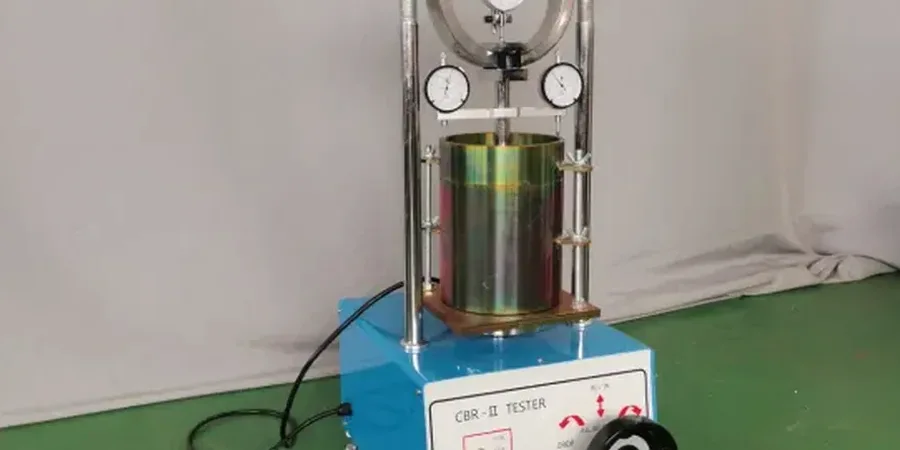
A CBR below 3 in saturated conditions means the subgrade requires stabilization before any pavement layer is placed.
Method and coverage
- Compacting soil at optimum moisture content per ASTM D698 or D1557
- Soaking specimens for 96 hours to simulate worst-case saturation
- Measuring penetration resistance at 0.1 and 0.2 inches
Regional considerations
Using a standard CBR value from a soil database instead of site-specific testing is a common mistake in Baton Rouge projects. The Mississippi River deposits vary laterally within a single street block — clay lenses, silt pockets, and sand seams change the bearing capacity drastically. A single CBR test per mile is rarely enough. We recommend one test every 500 feet along the alignment plus additional tests at intersections and drainage outfalls. Our field team uses a dynamic cone penetrometer for rapid profiling between laboratory CBR points.
Standards that apply
ASTM D1883-21, AASHTO T-193, FHWA NHI-05-037 (Pavement Design Guide)
Associated technical services
Subgrade stabilization evaluation
When CBR values fall below 5%, we recommend lime or cement stabilization. Our lab determines the dosage rate through unconfined compression tests on treated samples after 7-day curing.
Pavement layer thickness design
Using the CBR results and traffic load projections, we calculate flexible pavement layer thicknesses per AASHTO 1993 or Mechanistic-Empirical design methods.
Typical parameters
Common questions
What is the typical CBR value for soils in Baton Rouge?
Natural alluvial soils in Baton Rouge typically yield CBR values between 2.5% and 8% in soaked conditions. Clay-rich areas near the river may test below 3%, while sandy terraces east of the city can reach 10-15%. Every project requires site-specific testing because lateral variability is high.
How many CBR tests are needed for a road project?
For a typical subdivision street, one CBR test per 500 feet of alignment plus additional tests at culverts and intersections is standard. For major arterials or highways, we space tests every 300 feet and perform a DCP profile at every station for continuous coverage.
What is the difference between soaked and unsoaked CBR?
The soaked CBR simulates worst-case saturation after 96 hours of immersion. Unsoaked CBR represents the as-compacted condition. In Baton Rouge, soaked values are consistently 40-60% lower than unsoaked, so we always recommend soaked testing for pavement design in this humid climate.
How much does a CBR study for road design cost?
A standard CBR test including sample preparation, 96-hour soaking, and penetration testing costs between US$160 and US$280 per sample. Bulk discounts apply when testing five or more samples from the same project. The total study cost depends on the number of tests and the depth of sampling required.