Ground improvement in Baton Rouge represents a suite of engineered solutions designed to modify and enhance the mechanical properties of soil and rock at a project site. Given the region's complex subsurface conditions—ranging from soft, compressible clays of the Mississippi River Alluvial Plain to liquefiable sands in certain zones—these techniques are not merely optional but often essential for ensuring long-term stability and performance of infrastructure. The category encompasses methods that increase bearing capacity, reduce settlement, mitigate liquefaction potential, and control groundwater flow, directly addressing the geotechnical challenges that define construction across East Baton Rouge Parish.
The local geology is dominated by Quaternary alluvium deposited by the Mississippi River and its distributaries, resulting in thick sequences of soft, normally consolidated clays and loose silty sands. These deposits can extend to depths exceeding 100 feet, creating a high risk of excessive total and differential settlement under structural loads. Additionally, the high water table, often within a few feet of the ground surface, complicates excavation and foundation design. Seasonal fluctuations in the river and heavy rainfall events further exacerbate soil saturation, making unsaturated soil behavior a critical consideration. A thorough unsaturated soil analysis is frequently the first step in diagnosing the need for improvement and predicting the performance of various techniques under local climatic conditions.
Regulatory compliance in Baton Rouge is governed by the Louisiana State Uniform Construction Code, which adopts the International Building Code (IBC) with state-specific amendments. Chapter 18 of the IBC, which covers soils and foundations, mandates that structures be supported on engineered fill or improved ground where native soils are deemed inadequate. The East Baton Rouge Parish Department of Public Works also requires geotechnical reports for commercial and subdivision developments, where ground improvement designs must be sealed by a Louisiana-licensed professional engineer. Adherence to ASTM standards for material testing, such as D4716 for geotextile flow rates and D6913 for particle size analysis, is strictly enforced during quality control. These codes ensure that methods like deep soil mixing and preloading meet minimum safety factors against bearing failure and excessive settlement.
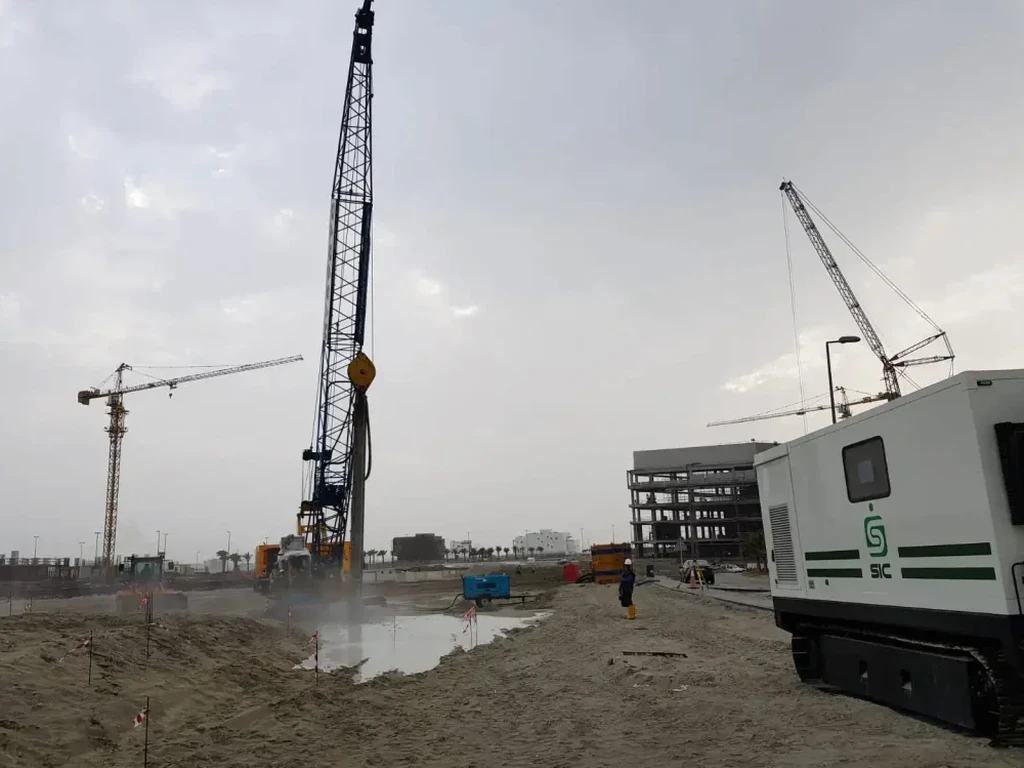
The types of projects that routinely require ground improvement in Baton Rouge are diverse and expanding. Heavy commercial developments, including hospitals and high-rise structures near the medical corridor, often rely on dynamic compaction design to densify loose granular soils and reduce post-construction settlement. Transportation infrastructure, such as the I-10 widening projects and levee upgrades, demands robust solutions for embankment stability on soft clays, where prefabricated vertical drain systems accelerate consolidation. Industrial facilities along the Mississippi River industrial corridor frequently employ geogrid and geotextile specifications to reinforce working platforms over very weak subgrades. Even residential subdivisions in areas like Central and Zachary are increasingly requiring geotechnical drainage design and surcharge programs to mitigate the effects of expansive or compressible soils on slab-on-grade foundations.
Available services
Unsaturated soil analysis
→ Ver detalleDynamic compaction design
→ Ver detalleDeep Soil Mixing (DSM) design
→ Ver detalleGeotechnical drainage design
→ Ver detallePrefabricated vertical drain (PVD) design
→ Ver detallePreloading with surcharge design
→ Ver detalleGeogrid specification
→ Ver detalleGeotextile specification
→ Ver detalleLime and cement stabilization
→ Ver detalleLandfill geotechnics
→ Ver detalleGeotechnical instrumentation (design and installation)
→ Ver detalleOrganic soil management
→ Ver detalleContaminated soil remediation
→ Ver detalleCommon questions
What are the primary benefits of ground improvement over traditional deep foundations in Baton Rouge?
Ground improvement often eliminates the need for expensive deep piles by treating the soil mass itself, increasing its bearing capacity and stiffness. In Baton Rouge's thick soft clays, this reduces settlement risks for large-area structures like warehouses and pavements, accelerates construction schedules by avoiding lengthy pile driving, and can be more cost-effective when dealing with variable subsurface conditions across a site.
How do I know if my Baton Rouge site requires ground improvement?
A comprehensive geotechnical investigation is the only definitive way. The report will flag issues like low Standard Penetration Test (SPT) blow counts (N-values), high organic content, or predicted settlements exceeding the structural tolerance (typically one inch for most buildings). If the bearing capacity is below 2,000 pounds per square foot or liquefaction potential is high, ground improvement is strongly recommended to meet IBC Chapter 18 requirements.
What are the most common ground improvement methods used in the Baton Rouge area?
Given the prevalence of soft clays and loose sands, common methods include prefabricated vertical drains with surcharge preloading to accelerate primary consolidation settlement, deep soil mixing to create soil-cement columns for structural support, and dynamic compaction for densifying loose granular fills. Geogrid reinforcement of aggregate layers is also standard for stabilizing working platforms over very weak, saturated subgrades.
How long does a typical ground improvement program take to complete in this region?
Duration varies significantly by method and soil conditions. A surcharge preloading program with PVDs may require three to six months of waiting for settlement, while deep soil mixing or vibro-compaction can be completed in a few weeks. The high water table and frequent rain in Baton Rouge can extend timelines if dewatering and site drainage are not adequately managed as part of the geotechnical drainage design.