A frequent mistake in Baton Rouge road projects is assuming the native Mississippi River alluvium can support a thick embankment without staged construction. The soft clays and silts here, with N-SPT values often below 4 blows/ft in the upper 20 feet, undergo significant consolidation under load. We have seen contractors place full-height fills in one lift, only to face differential settlements exceeding 12 inches within months. A proper road embankment design must account for the low undrained shear strength, typically 200-400 psf in the top stratum, and the presence of shallow groundwater at 3 to 6 feet. Our approach integrates In-Situ with a dilatometer test to evaluate lateral stress history, then applies staged loading with settlement monitoring to prevent shear failure in the foundation soils.
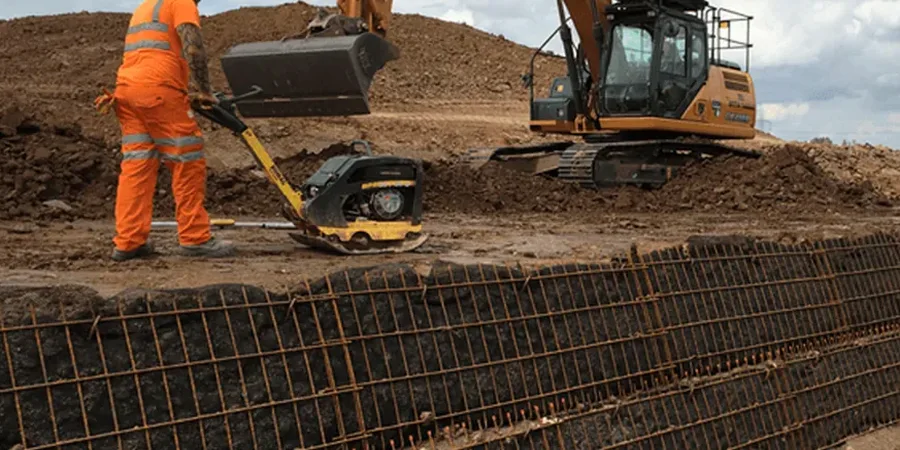
Staged construction with wick drains reduces post-construction settlement in Baton Rouge soft clays from 18 inches to under 3 inches.
Method and coverage
Regional considerations
The high water table in Baton Rouge, which fluctuates seasonally by 2 to 3 feet, poses a constant risk to road embankment design. During spring floods, the Mississippi River stage can raise the local groundwater level, reducing effective stress in the fill and triggering rotational slope failures. We have documented cases where embankments built without adequate drainage blankets suffered internal erosion and piping within 18 months of construction. To mitigate this, we always incorporate a geotextile-separated drainage layer at the base and specify a factor of safety of at least 1.5 for both short-term end-of-construction and long-term steady seepage conditions. A complementary slope stability analysis using Spencer's method helps verify the global stability of the embankment under these variable pore pressure regimes.
Process video
Standards that apply
ASTM D2435 (Consolidation Test), ASTM D4767 (Triaxial CU Test), AASHTO T-180 (Moisture-Density Relations), FHWA NHI-05-037 (Embankment Design Manual)
Associated technical services
Field Investigation & SPT Borings
Standard Penetration Tests with continuous sampling to identify soft layers and measure N-values for settlement estimates. We drill to at least 1.5 times the embankment height.
Consolidation & Triaxial Testing
Laboratory determination of compression index, preconsolidation pressure, and strength parameters using ASTM D2435 and D4767. Results are used for staged construction design.
Piezometer Installation & Monitoring
Vibrating-wire piezometers placed at multiple depths to track pore pressure dissipation during fill placement. Data is fed into real-time settlement analysis.
Settlement Monitoring & Surcharge Design
Installation of settlement plates and inclinometers to verify performance. We design surcharge heights and duration based on the required post-construction settlement tolerance.
Typical parameters
Common questions
What is the typical cost for a road embankment design study in Baton Rouge?
The cost for a comprehensive road embankment design study in Baton Rouge typically ranges from US$1,230 to US$3,810, depending on the embankment height, number of borings, and laboratory testing required. This includes field investigation, consolidation tests, and a design report.
How deep do I need to drill for a 12-foot embankment in Baton Rouge?
For a 12-foot embankment, we recommend drilling to at least 18 feet below the original ground surface, or to a depth equal to 1.5 times the embankment height. This ensures we capture the full compressible layer, which in Baton Rouge can extend 30 to 40 feet.
What settlement tolerance is acceptable for a road embankment?
For highway embankments in Baton Rouge, the typical post-construction settlement tolerance is 1 to 2 inches over 10 years. For bridge approaches, the tolerance is stricter at 0.5 inches. Our design uses wick drains or surcharge to meet these limits.
Do you recommend wick drains for all Baton Rouge embankments?
Not always. For embankments under 8 feet in height on sites with preconsolidated clays, staged construction without drains may suffice. However, for fills exceeding 8 feet on soft alluvium with N-SPT below 5, prefabricated vertical drains (PVDs) are strongly recommended to accelerate consolidation.
What is the difference between short-term and long-term stability in embankment design?
Short-term stability (end-of-construction) uses undrained shear strength parameters because the fill is placed faster than pore pressure can dissipate. Long-term stability uses drained parameters (c', phi') after consolidation. Both must be checked per FHWA guidelines, with a minimum factor of safety of 1.3 for short-term and 1.5 for long-term.