A common mistake we see in Baton Rouge construction projects is assuming that a simple fill slope will hold up on its own. The Mississippi River floodplain leaves thick deposits of soft clay and silt, often with perched water tables that turn a 2:1 slope into a slow-moving slide. We've been called in after retaining walls cracked and pavement slumped because the original design skipped a proper stability analysis. For cuts near the bluffs or excavations adjacent to existing structures, the first step is a detailed slope stabilization design that accounts for the low shear strength of Baton Rouge's alluvial soils. Combining limit-equilibrium with a falla de taludes back-analysis gives us the actual mobilized strength parameters, and we typically run a ensayo CPT to capture continuous profiles without disturbing the soft layers.
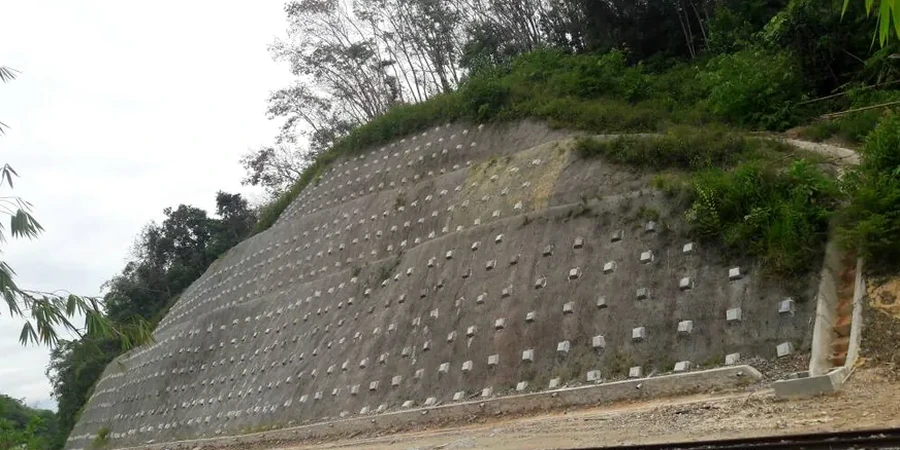
In Baton Rouge's deltaic clays, water control determines whether a slope stands or slides. A good drainage scheme is non-negotiable.
Method and coverage
- Limit-equilibrium analysis using Spencer and Morgenstern-Price methods
- FEM modeling for complex geometries near existing infrastructure
- Reinforcement options such as soil nails or geosynthetics
Regional considerations
ASCE 7-22 classifies Baton Rouge as Seismic Design Category C, which means we must check pseudostatic stability for peak ground accelerations around 0.15g. The soft alluvial profile amplifies ground motion, so a slope that passes static checks can still fail during a moderate earthquake if pore pressures build up. We follow FHWA-NHI-05-039 procedures for seismic slope stability and apply the NCEER liquefaction triggering curves to any loose sand lenses within the profile. In our experience, the biggest risk is leaving out the undrained strength reduction in the upper 3 meters, where the soil is often softest and most susceptible to cyclic softening.
Standards that apply
FHWA-NHI-05-039 (Slope Stability Reference Manual), ASCE 7-22 (Minimum Design Loads, Seismic Criteria), ASTM D1586-18 (Standard Test Method for SPT), ASTM D2487-17 (Unified Soil Classification)
Associated technical services
Detailed limit-equilibrium analysis
Using Spencer and Bishop methods with SLOPE/W software, we calculate factors of safety for circular and non-circular failure surfaces in Baton Rouge's layered alluvial soils.
Finite element modeling (FEM)
Plaxis 2D/3D models that simulate staged construction, groundwater drawdown, and reinforcement interaction for complex slope geometries near the Mississippi River bluffs.
Reinforcement and drainage design
Specification of soil nails, geotextiles, retaining walls, and subsurface drainage systems to achieve target stability under both static and seismic conditions.
Construction monitoring and QA/QC
On-site verification of nail installation, drainage placement, and fill compaction, with inclinometer and piezometer readings to confirm design assumptions.
Typical parameters
Common questions
What is the typical factor of safety required for slope stabilization design in Baton Rouge?
For permanent slopes under static conditions, we target a minimum factor of safety of 1.5. For temporary cuts or end-of-construction scenarios, 1.3 is acceptable. Seismic checks require at least 1.1 under the ASCE 7 pseudostatic criterion.
How does the Baton Rouge geology affect slope stabilization design?
The Mississippi River floodplain deposits thick layers of soft clay and silt with high plasticity. These soils lose strength when wet, so drainage design is critical. Shallow groundwater and the potential for liquefaction in sandy lenses also require careful attention in the stability analysis.
What is the approximate cost range for a slope stabilization design study in Baton Rouge?
For a typical residential or commercial project, the study including site investigation, laboratory testing, and analysis ranges from US$1.810 to US$6.450. The final cost depends on slope height, complexity, and the number of reinforcement alternatives evaluated.
Do you recommend soil nails or geosynthetics for Baton Rouge slopes?
Soil nails work well in stiff clays and silty sands where the ground can stand temporarily during excavation. For very soft clays or slopes with high groundwater, geosynthetic-reinforced fill or a tieback wall may be more appropriate. We evaluate each site individually based on stratigraphy and access.