Baton Rouge grew fast after the 1920s oil boom, turning swampy Mississippi floodplain into industrial zones and suburbs. That deltaic clay and silt, often soft near the surface, creates real challenges for pavement and slope work. Geocell design solves this by locking granular fill into a 3D honeycomb, spreading loads and stopping lateral movement. Before specifying geocells, we always run a classification of soils to match the cell type to the actual grain size. For heavy industrial access roads, we also check the California Bearing Ratio to confirm subgrade support.
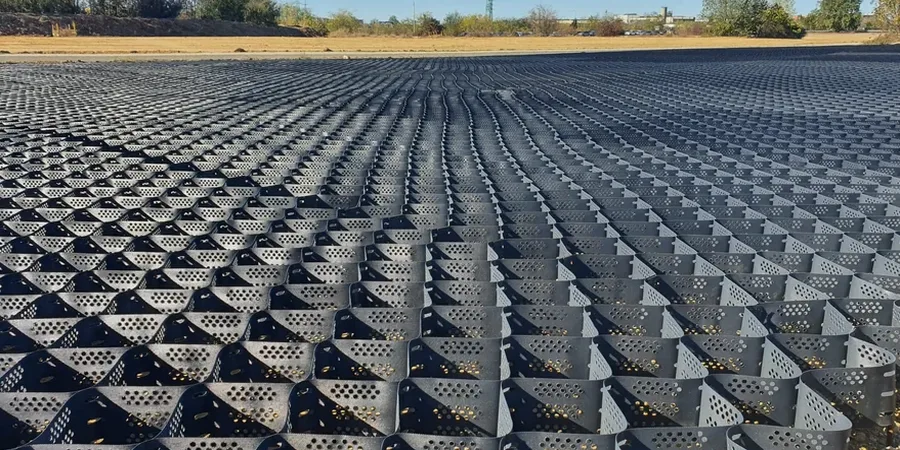
Geocell design cuts base thickness by 30 to 50 percent on Baton Rouge's soft deltaic clays while preventing lateral spread.
Method and coverage
Regional considerations
In Baton Rouge, many times we see geocell systems fail because the contractor skips the subgrade assessment. Soft clay under the cell expands when wet, and the whole panel bulges. Another common mistake is using a gravel that is too uniform. Angular crushed stone locks better than rounded river gravel. If the base is not properly compacted before placing the geocell, differential settlement happens within months. We also flag projects near the Comite River where seasonal flooding lifts the water table above the cell base. That requires a drainage blanket underneath.
Standards that apply
ASTM D1586 (Standard Penetration Test), ASTM D2487 (Unified Soil Classification), AASHTO M 288-21 (Geotextile Specification), AASHTO M 43 (Aggregate Sizing)
Associated technical services
Geocell for Load Support
For access roads, laydown yards, and parking lots on low-CBR subgrade. We calculate cell depth and infill type based on traffic volume and axle loads. Includes subgrade CBR testing and compaction verification.
Geocell for Slope and Erosion Control
Used on levees, drainage channels, and embankments. Cells hold topsoil and vegetation while resisting shear from rain and runoff. We design for Baton Rouge's 60-inch annual rainfall and 100-year storm events.
This service complements our laboratory testing work for a complete project analysis.
Typical parameters
Common questions
What is geocell design and how does it work?
Geocell design uses a three-dimensional honeycomb of polymeric strips to confine granular fill. The cells resist lateral movement, distributing vertical loads over a wider area. This improves bearing capacity and reduces base thickness.
How much does geocell design cost in Baton Rouge?
Typical costs range from US$720 to US$2.770 depending on cell depth, site access, and total area. This includes design calculations, material specification, and installation oversight. Contact us for a project-specific quote.
Can geocells replace traditional pavement?
Geocells are a reinforcement layer, not a pavement replacement. They work under asphalt, concrete, or gravel surfaces. On very weak subgrade (CBR under 3), they allow thinner pavement sections while preventing rutting.
What fill material works best with geocells?
Crushed angular stone (AASHTO #57 or #67) provides the best interlock. Sand works for erosion control but not for heavy loads. Avoid rounded river gravel because it does not lock into the cell walls and can shift under traffic.
How long does geocell installation last?
With proper design and drainage, a geocell system in Baton Rouge lasts 20 years or more. UV-stabilized polyethylene resists degradation. The main risk is clogging of infill by fine sediments, so a geotextile separator is recommended.