The contrast between Baton Rouge's high-bluff neighborhoods along the Mississippi and the low-lying areas near the Comite River tells a story of variable soils. Upland sites often encounter stiff clays and sands of the Pleistocene terraces, while the floodplain zones present soft Holocene silts and organic-rich clays. This variability makes deep soil mixing design a critical choice for Improvement in Baton Rouge. Before specifying DSM parameters, engineers must understand the local stratigraphy and groundwater conditions. A thorough study of soil mechanics provides the baseline data needed to select the correct binder type and mixing energy for each project zone.
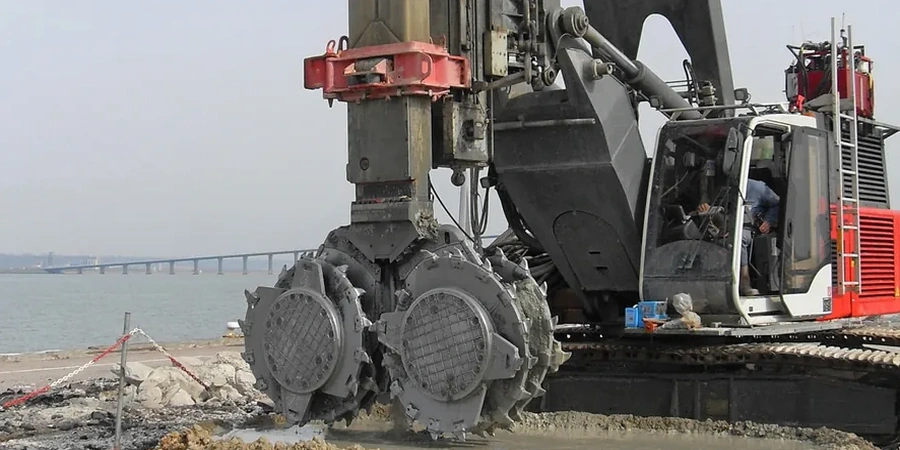
Baton Rouge's soft deltaic soils require DSM binder contents up to 400 kg/m³ to achieve target UCS values of 1–3 MPa.
Method and coverage
- Shaft rotation speed: 150–200 rpm
- Penetration rate: 0.3–1.2 m/min
- Binder content: 200–400 kg/m³ of soil
Regional considerations
The humid subtropical climate of Baton Rouge brings annual rainfall exceeding 1,500 mm, with tropical systems like Hurricane Katrina (2005) causing extreme flooding events. These conditions trigger high groundwater tables that can wash out fresh cementitious binders during DSM installation. Additionally, the region lies in seismic zone 1 per ASCE 7-22, where peak ground acceleration reaches 0.15g. Liquefaction of loose saturated sands beneath the DSM columns is a real risk. The design must verify that improved ground can resist both lateral spreading from seismic shaking and the uplift pressures generated by flood events.
Standards that apply
ASCE 7-22 Minimum Design Loads and Associated Criteria for Buildings and Other Structures, IBC 2021 International Building Code — Chapter 18: Soils and Foundations, ASTM D1586-18 Standard Test Method for Standard Penetration Test (SPT), ASTM D2487-17 Standard Practice for Classification of Soils for Engineering Purposes (Unified Soil Classification System), FHWA Geotechnical Engineering Circular No. 13: Ground Modification Methods (2017)
Associated technical services
Binder Mix Design Optimization
We conduct laboratory trials using Baton Rouge soil samples to determine the optimal binder type (cement, lime, slag, or combinations) and dosage. The mix design targets UCS values between 1.0 and 3.0 MPa at 28 days, while accounting for organic content and pH conditions typical of deltaic deposits.
Numerical Modeling of DSM Column Layout
Using finite element analysis (PLAXIS 2D/3D), we simulate load-settlement behavior of DSM-improved ground under static and seismic conditions. The model incorporates soil variability, column stiffness contrast, and interface shear strength to optimize spacing and depth for Baton Rouge projects.
Typical parameters
Common questions
What is the typical cost range for deep soil mixing design in Baton Rouge?
The cost for deep soil mixing design services in Baton Rouge typically ranges between US$1,430 and US$5,400, depending on project complexity, number of soil samples tested, and the extent of numerical modeling required. This includes laboratory mix design, parameter selection, and a detailed design report.
How does the high organic content in Baton Rouge soils affect DSM design?
Organic soils in the Baton Rouge floodplain can consume binder and delay strength gain. The pH of pore water often drops below 5 in peaty zones, requiring higher binder dosages (up to 400 kg/m³) and longer curing periods. Our laboratory trials adjust the binder composition to compensate for these conditions.
What seismic provisions apply to DSM design under the IBC?
Under IBC 2021 and ASCE 7-22, Baton Rouge falls within Seismic Design Category B. The DSM design must verify that improved ground does not liquefy during a design earthquake (2% probability in 50 years). We perform cyclic triaxial tests on DSM-treated samples to confirm shear strength degradation remains within acceptable limits.
Can DSM be used to mitigate settlement in Baton Rouge's soft clays?
Yes, DSM columns significantly reduce total and differential settlements by transferring loads to deeper, more competent strata. For typical Baton Rouge projects, a replacement ratio of 15-25% (column area to total area) can reduce settlement by 60-80% compared to untreated ground. The design must account for column-to-soil modulus ratios between 10 and 50.