Under ASCE 7 and IBC 2021, evaluating total and differential settlement in Baton Rouge is not optional — it is a structural safety requirement. The Mississippi River floodplain deposits here consist of soft clays, silts, and organic layers that can compress significantly under load. We have seen cases where ignoring consolidation behavior leads to floor slabs cracking within months of occupancy. That is why our team runs one-dimensional consolidation tests (ASTM D2435) and oedometer curves on undisturbed samples before any foundation design proceeds. For projects near the LSU campus or industrial corridors along the river, we also cross-check results with a plate load test to validate modulus of subgrade reaction values in situ.
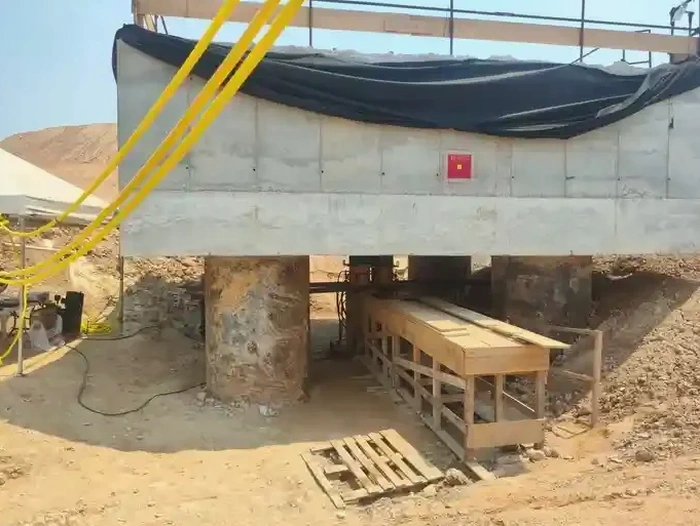
Total settlement exceeding 25 mm in Baton Rouge clay often correlates with seasonal water table fluctuations from the Mississippi River stage.
Method and coverage
Regional considerations
Differential settlement in Baton Rouge is the leading cause of non-structural damage in light commercial buildings. We have documented cases where a 30 mm difference between a slab-on-grade and a deep foundation column led to wall cracking and door misalignment within two years. The culprit is usually a thin organic silt lens that consolidates unevenly. Our mitigation approach includes preloading with sand surcharge for 60–90 days and installing vertical wick drains (ASTM D6913) to accelerate pore pressure dissipation. In extreme cases along the Amite River floodplain, we recommend transitioning to deep foundations using driven piles socketed into the Pleistocene sand layer at 20 m depth.
Standards that apply
ASTM D2435 (one-dimensional consolidation), ASTM D4767 (CU triaxial strength), IBC 2021 Section 1803 (geotechnical investigation), ASCE 7-16 (load combinations and settlement limits)
Associated technical services
Consolidation Testing & Settlement Modeling
One-dimensional oedometer tests per ASTM D2435 on undisturbed tube samples from depths up to 30 m. We output Cc, Cr, Cv, and preconsolidation pressure (σ'p) for time-rate settlement curves under service loads.
Plate Load Tests for Modulus Validation
In-situ plate load tests (ASTM D1196) on prepared subgrade to verify modulus of subgrade reaction (kv) used in raft foundation design. Typical load cycles reach 1.5× design bearing pressure.
Preload & Wick Drain Design
Feasibility study and design of surcharge fills with wick drain spacing to achieve 90% consolidation within 4–6 months. Monitored with settlement plates and piezometers per ASTM D5092.
Typical parameters
Common questions
How long does a settlement analysis take for a typical Baton Rouge project?
A full analysis — including sampling, consolidation testing, and modeling — usually takes 3 to 5 weeks. If we use existing borehole data from nearby sites, we can reduce that to 10–14 working days.
What causes differential settlement in Baton Rouge clays?
The primary cause is the presence of highly compressible organic silt lenses interbedded within the clay matrix. These lenses have much higher void ratios and lower Cv values, so they consolidate faster or slower than surrounding clays, creating uneven ground movement under load.
Can settlement be mitigated without deep foundations?
Yes — in many cases preloading with a sand surcharge combined with vertical wick drains can achieve sufficient consolidation within 3–6 months. This works well for warehouse slabs and light industrial floors where total settlement up to 40 mm is tolerable.