Baton Rouge sits on the Mississippi River's alluvial plain, where the top 20 to 30 meters consist of soft clays, silts, and loose sands with groundwater typically 2 to 4 meters below grade. These conditions make pile foundation design the standard approach for transferring structural loads to the underlying Pleistocene sands. Before specifying pile type or length, we correlate N-values from the ensayo SPT with bearing capacity using Meyerhof's method and the FHWA-driven pile manual. The city's seismic design category per IBC 2021 is D, driven by site class D soils, so we also evaluate liquefaction potential in saturated sand lenses.
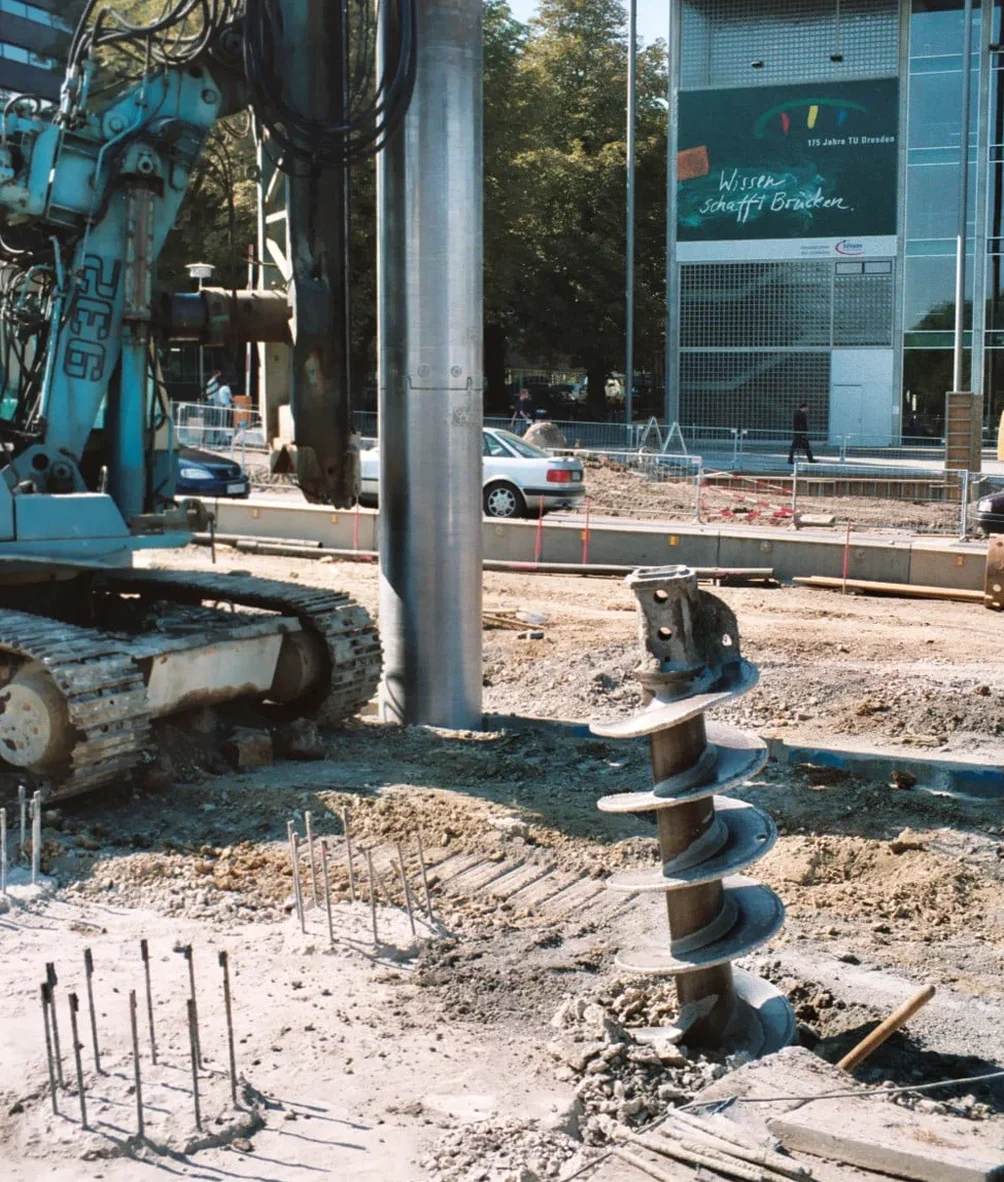
In Baton Rouge, pile capacity is often controlled by side friction in the upper clay, not end bearing — the sand is deep.
Method and coverage
- In the industrial corridor along River Road, high-capacity H-piles or 0.91-m diameter drilled shafts are common.
- In residential zones near the Comite River, shorter timber piles or micropiles are sized for lower loads.
Regional considerations
IBC 2021 chapter 18 requires deep foundation investigation for any structure in Seismic Design Category D, which applies to all Baton Rouge. The primary risk is downdrag on piles due to consolidation of soft clay under fill loads, plus lateral spreading during earthquakes in liquefiable sand layers. We model group effects using LPILE and SHAFT, and specify sacrificial steel thickness for driven piles in corrosive soils. A missing soil boring to 50 m depth can lead to under-designed pile groups and differential settlement exceeding 50 mm between adjacent columns.
Process video
Standards that apply
IBC 2021 – Chapter 18 (Soils and Foundations), ASTM D3966-22 – Standard Test Methods for Deep Foundations Under Static Axial Compressive Load, ASCE 7-22 – Minimum Design Loads and Associated Criteria (Seismic and Geotechnical), FHWA-NHI-05-042 – Design and Construction of Driven Pile Foundations
Associated technical services
Geotechnical Investigation & Boring Program
Continuous SPT borings to 50 m with undisturbed sampling in clay, plus CPT soundings for stratigraphic profiling. Laboratory tests include consolidation, direct shear, and triaxial CU on clay specimens.
Pile Type Selection & Structural Design
Structural sizing for driven H-piles, prestressed concrete, or drilled shafts. We calculate skin friction and end bearing using local correlations calibrated to Baton Rouge soil data, and verify with PDA or static load tests.
Seismic & Downdrag Analysis
Evaluation of liquefaction-induced lateral spreading, group pile effects, and negative skin friction. We provide settlement contours and pile group layouts for foundation plans.
Typical parameters
Common questions
What is the typical cost range for pile foundation design in Baton Rouge?
For a standard commercial project with 8 to 12 borings and design report, the range is US$1,680 to US$6,030 depending on depth, number of load tests, and seismic analysis required. This includes soil boring, laboratory testing, structural design calculations, and a final foundation report.
How deep do piles need to go in Baton Rouge?
Driven piles typically reach 25 to 45 meters to penetrate the Mississippi River alluvium and bear on the dense Pleistocene sand. In areas near the river, depths of 40 m are common; in the southern suburbs, 25 to 30 m often suffice. We confirm tip elevation based on SPT blow counts exceeding 50 blows per 0.3 m in the bearing stratum.
What is the difference between driven piles and drilled shafts for Baton Rouge soils?
Driven piles displace soil and develop higher side friction in clays, making them efficient for soft ground. Drilled shafts allow larger diameters (up to 1.5 m) but require casing in the upper 5 to 10 m to prevent collapse in saturated sand. For high lateral loads, drilled shafts with rock sockets in the Pleistocene sand are preferred.