Micropile design in Baton Rouge must account for the region's deep alluvial deposits and high water table, conditions that often rule out conventional shallow foundations. The city lies within the Mississippi River floodplain, where soft clays and loose sands extend hundreds of feet below grade. Our engineering team applies the latest IBC and ASCE 7 provisions to size micropiles that transfer structural loads through these weak upper strata down to competent bearing layers. Before finalizing the micropile layout, we typically integrate data from a dilatometer test to refine lateral load parameters and confirm soil modulus values. Each design is site-specific, considering local groundwater fluctuations and the presence of buried utilities or obstructions common in Baton Rouge's urban core.
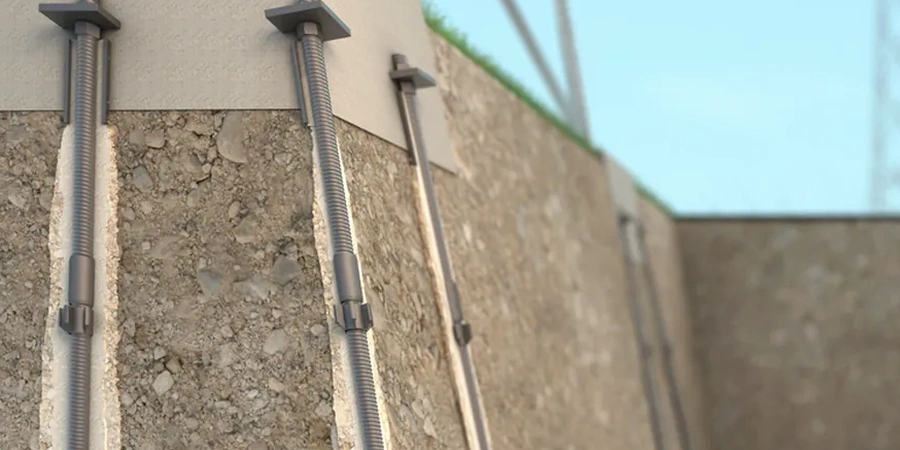
In Baton Rouge's deltaic soils, micropile design must address abrupt stratigraphy changes — a single SPT boring every 1,500 sq ft is our minimum standard.
Method and coverage
Regional considerations
A six-story hotel near the LSU campus was recently built on micropiles designed without considering the full depth of soft clay beneath Baton Rouge. The original design called for 40-foot micropiles, but after a load test failed at 60% of the design load, we were called in. Our investigation revealed a 15-foot-thick layer of organic silt at 38 feet that the borings had missed. We redesigned the micropiles to extend to 65 feet and added a steel casing through the silt zone. The project was delayed four months and cost $120,000 in rework. This scenario is avoidable with adequate site investigation integrated into the micropile design from the start.
Standards that apply
IBC 2021 (Chapter 18 – Soils and Foundations), ASCE 7-22 (Minimum Design Loads and Seismic Provisions), FHWA-HIF-07-029 (Micropile Design and Construction Guidelines), ASTM D1586-18 (Standard Penetration Test)
Associated technical services
Custom Micropile Foundation Design
Full structural and geotechnical design for new construction, including load testing specification, corrosion protection, and seismic detailing per ASCE 7. We produce stamped calculations and shop-ready pile layout drawings.
Micropile Retrofit & Underpinning Design
For existing structures experiencing settlement or requiring increased load capacity. Our team designs tie-back micropiles with minimal headroom equipment, ideal for Baton Rouge's historic district and tight urban infill sites.
Typical parameters
Common questions
What makes micropile design in Baton Rouge different from other cities?
Baton Rouge sits on deep Mississippi River alluvium — soft clays, silts, and loose sands that require micropiles to reach 50 to 100 feet for competent bearing. The high water table also demands sealed casing during drilling to prevent cave-ins. Our designs account for these local conditions specifically.
How many SPT borings are needed for a micropile design on a typical Baton Rouge lot?
We recommend one SPT boring per 1,500 square feet of building footprint, with a minimum of two borings per site. For irregular or large lots, we increase the density to capture the stratigraphic variability common in Baton Rouge's floodplain geology.
What is the typical cost range for micropile design services in Baton Rouge?
Design fees typically range from US$1,530 to US$5,040 depending on the number of pile types, complexity of the load conditions, and whether load testing is included. This covers all calculations, drawings, and construction support.
Can micropiles be used for seismic retrofitting in Baton Rouge?
Yes. Micropiles are well-suited for seismic retrofits because they can be installed in confined spaces with minimal vibration. Our designs incorporate ASCE 7 seismic load combinations and account for the site class based on measured vs30/" data-interlink="1">shear wave velocity. We often pair them with grade beams to create a continuous load path.
What is the typical grout mix used in Baton Rouge micropiles?
We specify a neat cement grout with a water-to-cement ratio of 0.40 to 0.45, achieving 5,000 psi at 28 days. For aggressive groundwater conditions, we add a corrosion-inhibiting admixture. The grout is placed under pressure through the drill casing to ensure complete void filling.