In Baton Rouge, the Mississippi River has left behind a complex layering of silty clays, sands, and organic deposits. That means deep excavations here behave differently than in stiff clay or rock environments. We see it on every project: groundwater control is the first challenge, followed by lateral wall deflections. A solid design combines subsurface exploration with numerical modeling. Before we finalize shoring layouts, we often run a cone penetration test to get continuous soil profiles. That data feeds directly into our wall stability checks and settlement estimates.
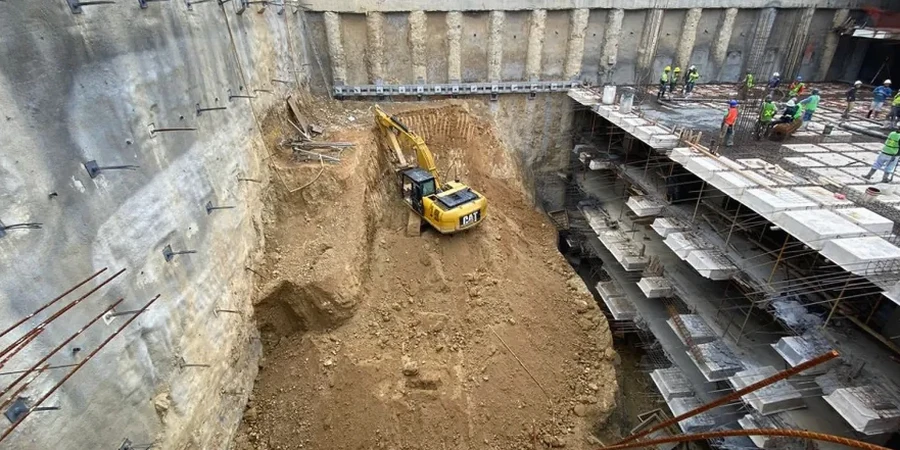
The Mississippi River's ancient channels created a deep deposit of soft clay. Ignoring that layer can double shoring costs.
Method and coverage
- Finite element analysis for wall deflections and ground movements
- Basal heave verification for excavations wider than 20 feet
- Dewatering system design to keep the working face dry
Regional considerations
The Mississippi River Valley has a high water table. In Baton Rouge, static water levels sit just 5 to 10 feet below grade. That makes deep excavations a battle against groundwater seepage and piping. Flooding from heavy rain events adds another layer of risk. We design dewatering systems that handle a 25-year storm event, and we always include standby pumping capacity. The soft clay layers also pose a bottom heave risk when excavation width exceeds depth. Our analyses check for that failure mode before construction starts.
Standards that apply
ASCE 7-22 (earth loads and hydrostatic pressures), IBC 2021 Chapter 18 (excavation support), FHWA NHI-05-037 (temporary shoring design), ASTM D1586-18 (soil sampling for strength parameters)
Associated technical services
Shoring and Support Systems
Design of soldier piles, sheet piles, secant piles, and tiebacks. We calculate lateral loads, bending moments, and wall embedment depths per AASHTO and IBC. All designs include structural connections and corrosion protection for permanent elements.
Groundwater Control Design
Sizing of deep wells, wellpoints, and sump systems to lower the water table during excavation. We run seepage models to predict drawdown and settlement impact on adjacent structures. Emergency bypass piping is part of every plan.
This service complements our laboratory testing work for a complete project analysis.
Typical parameters
Common questions
How deep can we excavate in Baton Rouge without shoring?
In most of Baton Rouge, open-cut excavation without shoring is limited to about 8 to 10 feet in stiff clay. Below that, the soft clay and high water table require support. Local code typically mandates shoring for excavations deeper than 5 feet when workers are inside.
What is the cost range for deep excavation design in Baton Rouge?
A complete geotechnical design package for deep excavations in Baton Rouge typically ranges from US$2,360 to US$9,520. The final cost depends on excavation depth, wall type, and dewatering complexity. We provide firm quotes after reviewing the site conditions.
Do we need a dewatering permit for deep excavations in Baton Rouge?
Yes. The Louisiana Department of Environmental Quality requires a permit for groundwater withdrawal exceeding 50,000 gallons per day. Our designs include the necessary calculations for permit applications, including water quality sampling and discharge plans.
What soil parameters are critical for deep excavation design in Baton Rouge?
Undrained shear strength of clay layers, friction angles of sand layers, and groundwater elevation are the three most important parameters. We also need modulus values for wall deflection analysis. These are obtained from lab tests on undisturbed samples and CPT data.