Baton Rouge sits on deep alluvial deposits of the Mississippi River, with soft clays and silty sands extending over 200 meters in places. That thick sedimentary column amplifies seismic waves from distant New Madrid earthquakes. A site response analysis here isn't optional for critical structures — it's the only way to predict how local soil layers will modify bedrock motion. We combine vs30/" data-interlink="1">shear wave velocity profiling with nonlinear deformation modeling to capture the Baton Rouge response accurately. Before running the analysis, we often recommend a MASW survey to map VS30 across the site and a microtremor HVSR to identify the fundamental resonance frequency.
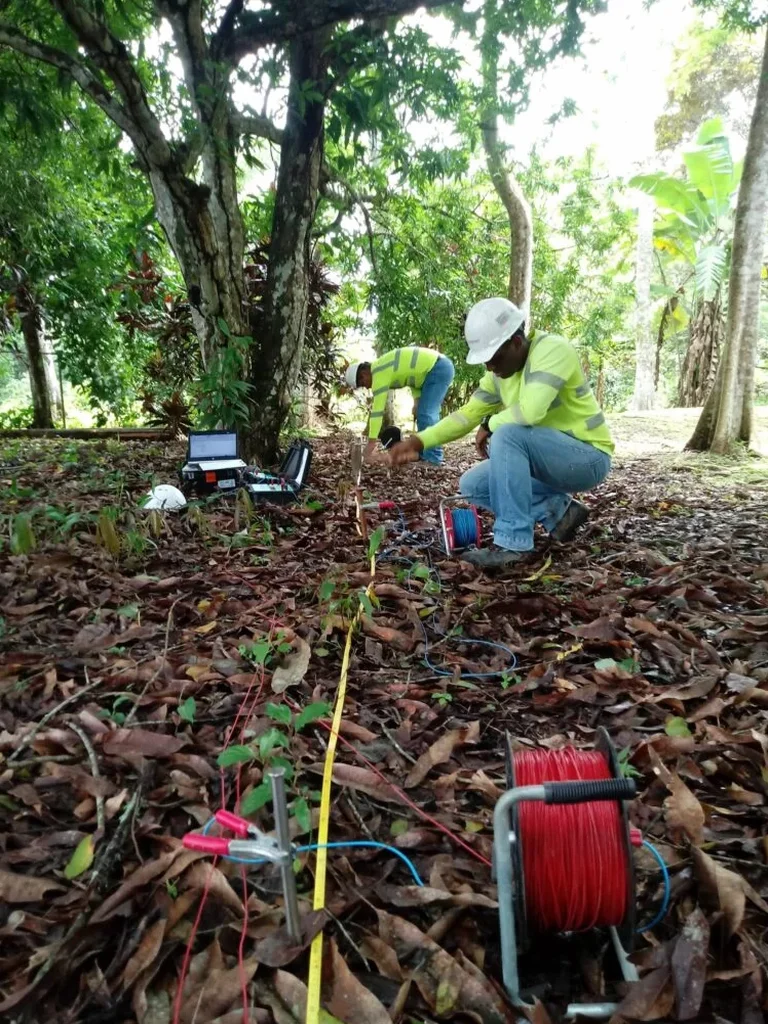
Soft alluvial soils in Baton Rouge can amplify ground motions by a factor of 2 to 4 compared to rock sites within the same seismic zone.
Method and coverage
Regional considerations
Compare the LSU campus area with the industrial corridor along the Mississippi. On campus, stiff Pleistocene terraces sit near the surface — site response is moderate. But along the river, soft Holocene clays extend over 40 meters deep. That same earthquake will shake a plant foundation much harder. We've seen amplification factors above 3.0 in those riverfront zones. Buildings on shallow footings in the soft belt need a careful site response analysis to avoid resonance with the soil column. The Baton Rouge seismic hazard map from USGS shows PGA values around 0.1g, but local soils can double that at the surface.
Standards that apply
ASCE 7-22 (Minimum Design Loads and Associated Criteria for Buildings), IBC 2021 (International Building Code), NEHRP Recommended Seismic Provisions (FEMA P-1050), ASTM D4428/D4428M (Crosshole Seismic Testing)
Associated technical services
Equivalent-Linear Site Response Analysis
Uses SHAKE2000 or DEEPSOIL with modulus reduction curves for Baton Rouge clays. Output includes acceleration response spectra, Fourier amplification ratios, and strain-compatible soil properties at each layer.
Nonlinear Time-History Analysis
Advanced modeling with DMOD2000 for large-strain scenarios. Captures pore pressure buildup and stiffness degradation in soft Baton Rouge soils. Recommended for critical facilities like hospitals and chemical plants.
Typical parameters
Common questions
Why is site response analysis important in Baton Rouge?
Baton Rouge's deep alluvial soils amplify earthquake motions from distant sources like the New Madrid Seismic Zone. Without site response analysis, a building designed to code may still experience ground shaking two to three times stronger than assumed.
What is the difference between VS30 and site response analysis?
VS30 gives you the average shear wave velocity in the top 30 meters — it's a site classification tool. Site response analysis goes further by modeling the complete soil column, including layer stiffness, damping, and nonlinear behavior to produce a site-specific design spectrum.
How much does site response analysis cost in Baton Rouge?
Typical costs range between US$1,420 and US$4,740 depending on the number of profiles, depth of boreholes, and whether you need equivalent-linear or full nonlinear analysis. Larger industrial projects with multiple locations fall at the higher end.
Which Baton Rouge areas have the highest seismic risk?
The industrial corridor along the Mississippi River, including Port Allen and Plaquemine, has the softest soils and highest amplification. Downtown Baton Rouge near the bluff has firmer Pleistocene deposits and lower amplification. Site-specific analysis is the only way to quantify the difference.