Many construction teams in Baton Rouge assume utility lines follow the city's original blueprints from the 1950s. That assumption causes costly hits on abandoned pipelines, old gas mains, and unrecorded fiber optics buried beneath Mississippi River alluvium. A GPR (Ground Penetrating Radar) survey delivers real-time subsurface imaging without excavation, letting project managers map existing utilities before breaking ground. When combined with a calicata exploratoria for physical verification, the radar profiles confirm depth and material type of each buried object. This two-step approach drastically reduces change orders during foundation work across Baton Rouge.
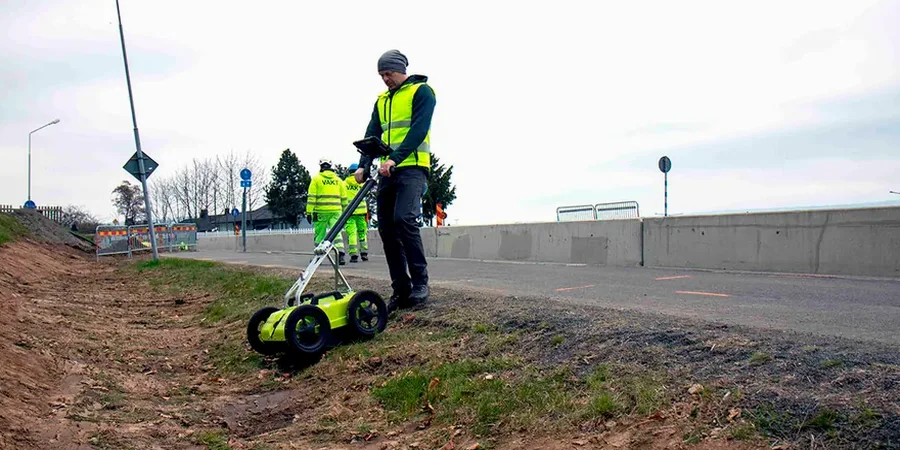
Radar profiles confirm depth and material type of buried objects, drastically reducing change orders during foundation work across Baton Rouge.
Method and coverage
- Grid layout over the target area using total station or GPS
- Data collection with 250–900 MHz antennae depending on depth
- Post-processing with migration filters and 3D time-slice software
Regional considerations
Baton Rouge sits on approximately 60 meters of Holocene alluvial deposits from the Mississippi River, with a water table that often sits less than 3 meters below grade. This high moisture content attenuates radar signals faster than dry sands, reducing effective penetration from 7 meters to around 3 meters in heavy clay. If a contractor skips a GPR (Ground Penetrating Radar) survey and relies solely on historical as-builts, the chance of striking an unmarked high-pressure gas line increases significantly. The city's 2020 infrastructure report documented 132 utility strikes in the metropolitan area, many of which could have been avoided with pre-excavation radar mapping.
Standards that apply
ASTM D6432-19 (Standard Guide for Using the Surface Ground Penetrating Radar Method), ASCE 38-22 (Standard Guideline for the Collection and Depiction of Existing Subsurface Utility Data), FHWA-HRT-19-009 (Ground Penetrating Radar for Bridge Deck Evaluation – Reference Manual)
Associated technical services
Utility Location and Mapping
Scan for metallic and non-metallic pipes, conduits, and fiber optic cables prior to excavation. Deliverable: CAD or GIS overlay with depth annotations.
Concrete Slab and Deck Scanning
Identify rebar spacing, post-tension cables, and voids inside reinforced concrete before coring or cutting. Suitable for bridge decks, parking garages, and industrial floors.
Void and Anomaly Detection
Detect sinkholes, old cisterns, or loose backfill beneath pavements and building slabs. Common along Florida Boulevard and Nicholson Drive where aging drainage structures collapse.
This service complements our laboratory testing work for a complete project analysis.
Typical parameters
Common questions
How deep can a GPR (Ground Penetrating Radar) survey penetrate in Baton Rouge's clay soils?
In the silty clay layers typical of East Baton Rouge Parish, depth penetration reaches 2 to 4 meters with a 250 MHz antenna. Wet, conductive clays reduce signal strength faster than dry sands, so maximum depth is often achieved in winter months when the water table drops slightly.
What is the typical cost range for a GPR (Ground Penetrating Radar) survey in Baton Rouge?
For a standard utility-location survey covering up to 10,000 sq ft, the cost ranges between US$1,260 and US$8,160 depending on antenna selection, grid density, and reporting requirements. Larger sites or deeper scans with multiple frequencies increase the upper end of that range.
Can GPR detect plastic or concrete pipes that metal detectors miss?
Yes. GPR detects any object with a dielectric contrast against the surrounding soil, including PVC, HDPE, concrete, and clay pipes. This is a key advantage over electromagnetic locators, which only find metallic utilities. In Baton Rouge's historic districts, many abandoned water mains are vitrified clay or transite, invisible to standard cable locators.