In Baton Rouge the biggest challenge for deep foundations and slab-on-grade work is the thick layer of soft to medium stiff clay that underlies much of the city. This Holocene alluvium deposited by the Mississippi River exhibits high compressibility and low undrained shear strength, which means that without a proper oedometer consolidation test the settlement estimates for a new building can be off by several inches. We run incremental loading oedometer tests on undisturbed samples to determine the preconsolidation pressure and compression index, data that directly feeds into the bearing capacity analysis and the decision between a shallow foundation versus deep piles. For sites near the LSU lakes or along the industrial corridor, the consolidation characteristics also inform the need for surcharge preloading, and we often integrate this data with a study of settlement behavior to validate the time-rate predictions against field monitoring.
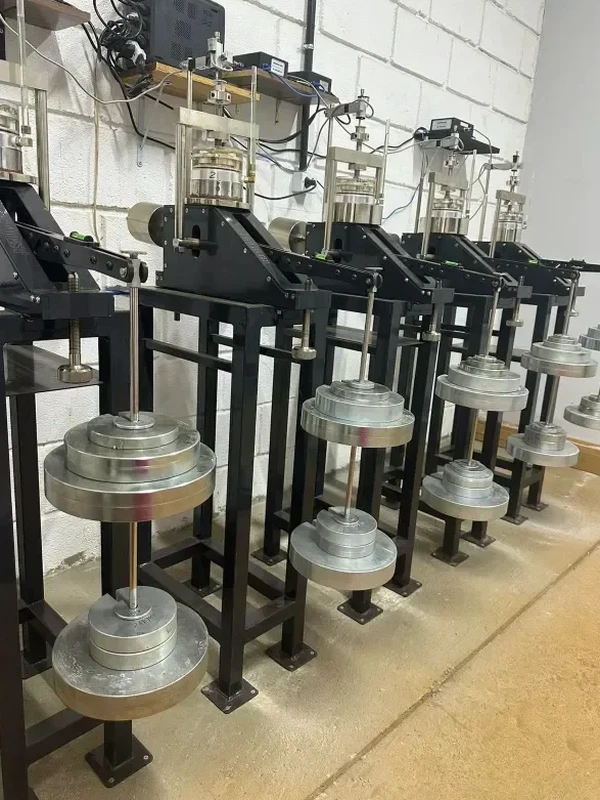
A single oedometer curve from a Baton Rouge clay sample can predict whether a foundation will settle 2 inches or 8 inches over 30 years.
Method and coverage
Regional considerations
The difference between a site near the Mississippi River levee and one east of Airline Highway is significant. The riverfront areas have recent soft clay deposits with high natural water content (40–60%), while the eastern part of Baton Rouge sits on older Pleistocene terrace soils that are stiffer and less compressible. If the engineer assumes a uniform soil profile based on surface observations alone, the settlement under a 10-story building could be underestimated by 40% or more in the soft clay zones. An oedometer test on samples from the correct depth interval is the only reliable way to capture the consolidation behavior that drives long-term differential movement.
Standards that apply
ASTM D2435-11 (Standard Test Methods for One-Dimensional Consolidation Properties of Soils), ASTM D1586-18 (Standard Test Method for Standard Penetration Test), ASTM D2487-17 (Standard Practice for Classification of Soils for Engineering Purposes)
Associated technical services
Incremental Loading Oedometer
Standard 7–10 step loading with 24-hour duration per load, reporting Cc, Cr, Cv, and preconsolidation pressure for clay and silt soils.
Constant Rate of Strain (CRS) Test
Faster alternative to incremental loading, ideal for low-permeability clays; provides continuous stress-strain curve in less than 8 hours.
Secondary Compression (Creep) Analysis
Extended loading phase (48–72 hours per load) to determine Cα for organic soils and peaty layers common in floodplain areas.
Swelling Pressure Test
Zero-volume swell test on compacted or undisturbed specimens to evaluate heave potential in expansive clay layers beneath slabs.
Typical parameters
Common questions
What is the difference between an oedometer consolidation test and a one-dimensional compression test?
In practice they are the same test. The oedometer test applies vertical load increments while preventing lateral deformation, exactly matching the one-dimensional compression condition. The term 'oedometer' refers to the specific apparatus (consolidometer) used to perform the test. Both produce the same compression and consolidation parameters.
How much does an oedometer consolidation test cost in Baton Rouge?
The typical cost for a standard incremental loading oedometer test on one undisturbed specimen ranges from US$210 to US$440, depending on the number of load steps and whether secondary compression analysis is included. Bulk pricing is available for multi-specimen projects.
When should I request an oedometer test instead of just a consolidation index from empirical correlations?
Empirical correlations from liquid limit and natural void ratio can give a rough Cc estimate, but they miss site-specific factors like overconsolidation from desiccation or past loading. For any building with a design settlement tolerance below 1 inch, or for sites where the clay thickness exceeds 10 feet, we recommend direct oedometer testing on undisturbed tube samples.
Can the oedometer test be performed on disturbed (bulk) samples?
No. The test requires an undisturbed specimen with its natural void ratio and structure intact. Bulk samples from test pits or auger cuttings cannot be used because remolding destroys the fabric that controls the preconsolidation pressure and compression behavior. Only thin-walled tube samples (Shelby tubes) or high-quality block samples are acceptable.