Building a road in Baton Rouge means dealing with the Mississippi River floodplain legacy: soft clays, silts, and high water tables. Many projects underestimate how much the subgrade stiffness controls pavement life. A proper road subgrade design here starts with understanding the soil's California Bearing Ratio (CBR) and its moisture sensitivity. Before placing any base layer, we recommend a CBR vial test to establish the soaked strength, and then a clasificacion suelos to confirm the AASHTO classification. Without that baseline, the pavement will rut or crack within months. The local geology demands a conservative approach, especially for collector streets and industrial access roads.
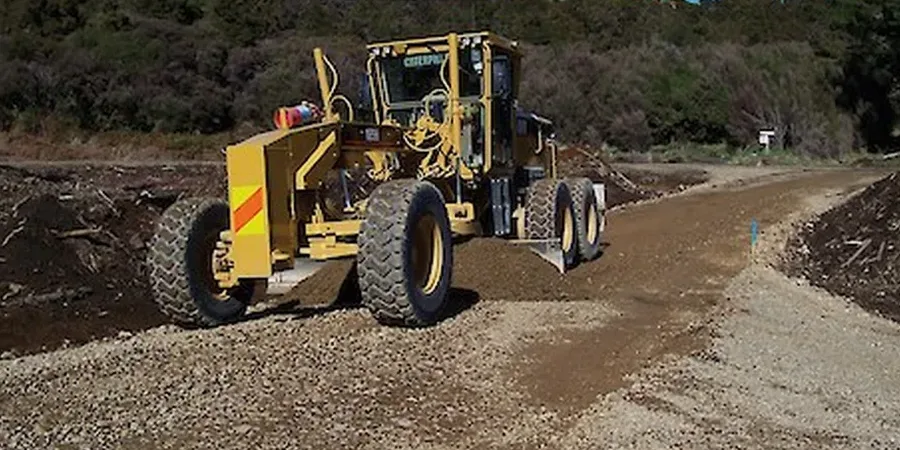
In Baton Rouge alluvium, a soaked CBR below 3 means the subgrade must be stabilized before any pavement is placed.
Method and coverage
- CBR test at 95% Standard Proctor density
- Atterberg limits per ASTM D4318
- Natural moisture content and density
Regional considerations
The combination of high plasticity clays and a shallow water table creates the classic Baton Rouge subgrade failure: loss of support after rain. If the road subgrade design ignores the soaked CBR, the pavement will rut, crack, or settle unevenly within the first wet season. Another risk is swelling: CH clays can expand up to 10% under moisture changes, lifting the pavement and breaking the surface. This is not a theoretical problem. Local subdivisions and industrial yards have experienced pavement failures within three years of construction because the subgrade was not properly evaluated. A thorough design must include moisture control through subdrains or a capillary break layer.
Process video
Standards that apply
ASTM D1883 (CBR), ASTM D698 (Standard Proctor), AASHTO M 145 (classification), ASTM D4318 (Atterberg limits)
Associated technical services
CBR Testing & Subgrade Evaluation
In-situ and laboratory CBR tests per ASTM D1883, including soaked conditions to simulate worst-case moisture. We provide the design CBR value for pavement thickness calculations, plus recommendations for subgrade improvement if the CBR is below 3.
Soil Stabilization Design
If the natural subgrade is too weak, we design lime or cement stabilization to raise the CBR to a target of 10 or higher. The mix design is based on Atterberg limits, pH, and unconfined compressive strength tests on treated samples.
Subsurface Drainage Analysis
To control the water table effect, we design subdrains, edge drains, or capillary break layers. The analysis includes permeability testing and groundwater monitoring to ensure the subgrade remains dry during the pavement's service life.
Typical parameters
Common questions
What is the typical CBR value for Baton Rouge subgrade soil?
The soaked CBR for the Mississippi alluvium in Baton Rouge typically ranges from 2 to 8. CL clays with low plasticity may reach 6-8, while CH clays often test below 4. The value depends on moisture content at compaction and the natural density.
How much does road subgrade design cost in Baton Rouge?
The cost for a complete road subgrade design study, including CBR testing, Atterberg limits, and recommendations, ranges between US$1.050 and US$3.350 depending on the number of test pits and the required laboratory tests. This includes the site visit and a written report.
Do I need a geotextile layer for my Baton Rouge road project?
Yes, if the subgrade CBR is below 3 or if the soil is highly plastic (PI > 35). A geotextile separation layer prevents the base material from mixing with the soft subgrade, maintaining the pavement structure's integrity. It is standard practice for low-volume roads in the region.
What is the difference between soaked and unsoaked CBR for subgrade design?
The soaked CBR simulates the worst-case moisture condition after rain, which is critical in Baton Rouge due to the high water table. The unsoaked CBR is typically 2-3 times higher but does not represent the in-service condition. We always design based on soaked CBR for permanent roads.
Can I use lime stabilization for a road subgrade in Baton Rouge?
Yes, lime stabilization is effective for CL and CH clays with a PI above 15. It reduces plasticity, increases workability, and raises the soaked CBR to 8-12. We perform a mix design with 3-6% lime by dry weight, followed by 7-day curing and CBR testing to verify the target strength.