We run the SPT (Standard Penetration Test) strictly to ASTM D1586-18, and in Baton Rouge that standard matters more than most people realize. The city sits on deep Mississippi River alluvial deposits — silty sands, soft clays, and occasional gravel lenses — that can vary dramatically within a single block. A standard boring with SPT every 1.5 meters gives us the blow counts (N-values) needed to classify the soil and estimate relative density or consistency. Before we mobilize the rig, we often recommend a georradar GPR scan to locate buried utilities or obstructions common in older parts of town. For projects near the riverfront, we also check for shallow groundwater during the SPT, since the water table sits only 2 to 4 meters down in most of East Baton Rouge Parish.
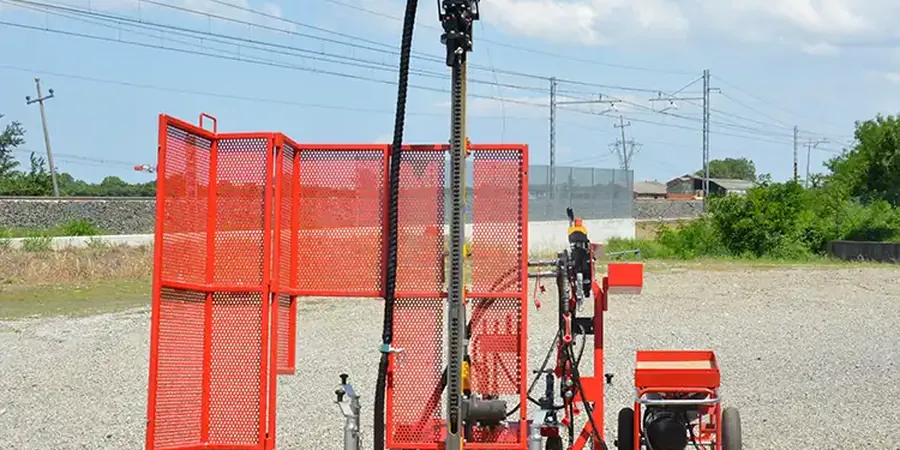
In Baton Rouge, the Mississippi River alluvium creates low N-values in the upper 10 meters — SPT data is your only reliable guide for pile design.
Method and coverage
- Continuous sampling at 1.5 m intervals to 15 m depth
- Field recording of N60 and N70 blow counts
- Recovery ratio and sample description per ASTM D2488
- Transport to lab for moisture content and Atterberg limits
Regional considerations
The Mississippi River has been depositing sediment here for millennia, and that legacy creates a real risk: loose, saturated sands in the upper 6 meters that can liquefy during even a moderate earthquake. Baton Rouge sits in Seismic Design Category C per ASCE 7, so ignoring the SPT’s N-values in these zones can lead to foundation settlement or lateral spreading. We have seen projects where a single SPT boring revealed a 3-meter clay lens sandwiched between sandy layers — information that completely changed the pile tip elevation. Without the SPT, that clay lens would have gone unnoticed until the pile hit refusal mid-drive. Every split-spoon sample we pull in Baton Rouge adds a layer of certainty to the geotechnical model.
Standards that apply
ASTM D1586-18, ASTM D2487 (USCS Classification), IBC 2021 (Chapter 18), ASCE 7-22 (Seismic Site Class)
Associated technical services
Standard SPT Borings
Full-depth borings with SPT at 1.5 m intervals, automatic hammer, field logging, and lab classification. Suitable for residential, commercial, and industrial projects in alluvial soils.
SPT with Seismic Cone Correlation
We combine SPT data with CPT soundings at selected locations to build a continuous profile of soil behavior type and relative density. Useful for site response analysis in Baton Rouge.
Typical parameters
Common questions
How deep do you typically drill SPT borings in Baton Rouge?
For most projects we go to 15 meters, which covers the active zone of alluvial deposits. Deeper borings (20-25 m) are common near the river or for heavy structures like bridge abutments.
How much does an SPT test cost in Baton Rouge?
A standard SPT boring with sampling and lab classification runs between US$550 and US$660 per borehole. The final quote depends on depth, number of borings, and site access.
Can you run SPT in wet ground or after heavy rain?
Yes, we use hollow-stem augers with a center plug to keep the borehole open. In Baton Rouge, where the water table is high, we also case the upper section to prevent caving.
What is the difference between N60 and raw blow count?
Raw blow count (N) is measured in the field. N60 corrects that value to 60% hammer efficiency, making it comparable across rigs. We always report N60 for design per ASTM D1586-18.