In Baton Rouge, many times we see pavements that fail prematurely because the subgrade conditions were not properly assessed before overlay or reconstruction. The Mississippi River floodplain deposits that underlie most of the city create highly variable support conditions, with soft clays and silty sands changing within meters. A thorough existing pavement evaluation identifies the cause of distresses like alligator cracking or rutting, and guides the selection of rehabilitation strategies. For rehabilitation projects on state highways, we often combine falling weight deflectometer testing with a subgrade soil classification to map bearing capacity across the corridor before designing the structural section.
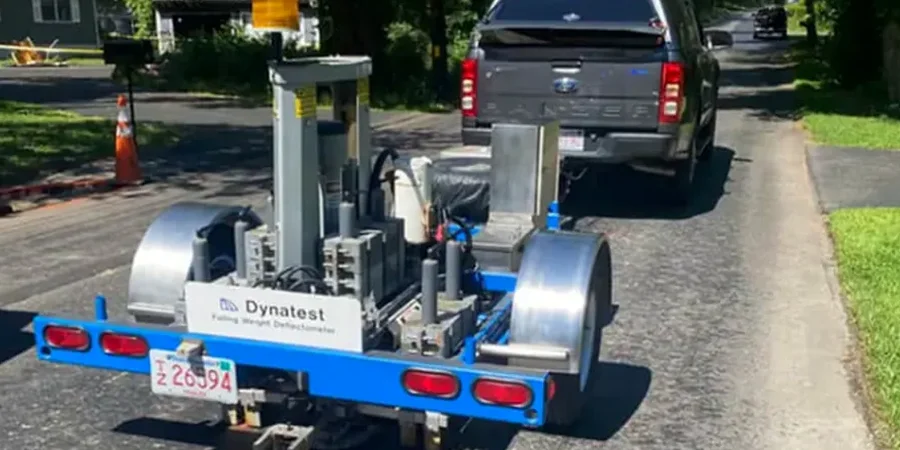
Rehabilitation without a proper pavement evaluation is speculation: FWD data alone can reduce overlay thickness by up to 30 percent in Baton Rouge's alluvial soils.
Method and coverage
Regional considerations
Baton Rouge has expanded rapidly since the 1950s, with many residential subdivisions built on drained swampland that was never properly compacted. The risk of constructing an overlay on a pavement that looks sound but sits on a weak subgrade is real: within two years, reflective cracking and settlement can erase the investment. We have documented cases where FWD deflections exceeded 60 mils under a standard 40 kN load, indicating that the subgrade had liquefaction potential during wet seasons. A proper existing pavement evaluation in Baton Rouge must account for the high water table and the presence of organic soils, which can degrade further when the pavement is opened and moisture intrudes.
Process video
Standards that apply
ASTM D4694-09 (FWD), ASTM D4695-03 (Deflection Measurements), ASTM D6951-18 (DCP), AASHTO T-193 (CBR), IBC 2021, Section 1803 (Geotechnical Investigation)
Associated technical services
FWD Structural Evaluation
Deflection basin analysis with backcalculation of layer moduli. We use a Dynatest 8000 FWD and report subgrade modulus, effective structural number, and remaining life per AASHTO 1993.
Pavement Coring and Profiling
Coring through asphalt and concrete to measure thickness, take samples for lab testing (Marshall stability, indirect tensile strength), and identify debonding or stripping between layers.
Subgrade and Base Assessment
DCP testing at 50 m intervals, CBR sampling, and laboratory classification (Atterberg limits, moisture content). We correlate results with FWD data to map weak zones.
Typical parameters
Common questions
How long does an existing pavement evaluation take in Baton Rouge?
A typical evaluation for a 1 km stretch of road takes two to three days of field work: FWD testing, coring at 3 locations, and DCP profiling every 50 m. Laboratory analysis and reporting require another five to seven business days.
Is FWD testing better than coring for assessing pavement condition?
They serve different purposes. FWD measures the structural response of the entire pavement system and identifies weak subgrade zones without destructive sampling. Coring gives you exact layer thickness and material quality. A complete evaluation in Baton Rouge uses both to cross-validate results.
What is the typical cost range for a pavement evaluation in Baton Rouge?
For a standard project covering up to 2 km of road or a parking lot up to 5 acres, the cost ranges between US$1.250 and US$4.220, depending on the number of FWD test points, coring locations, and laboratory tests required. We provide a fixed price after reviewing the site plan.