A geogrid installation crew in Baton Rouge typically mobilizes with a tractor-mounted unrolling attachment and a handheld tensioning bar. The geogrid roll sits on a spindle behind the tractor; as the machine moves forward, the grid unrolls onto the prepared subgrade. Workers then stretch the material manually to remove wrinkles and pin it with 600 mm steel staples. This method works well on the relatively flat terrain of East Baton Rouge Parish, where the Mississippi River floodplain produces silty clay subgrades that require careful geogrid specification to avoid overstressing the apertures during unrolling.
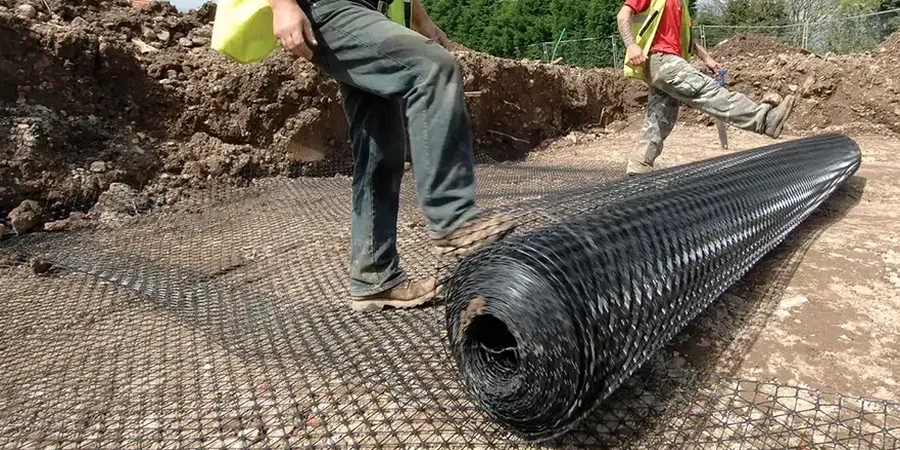
A geogrid specified without considering the local alluvial clay creep behavior can lose 40% of its design strength within 10 years.
Method and coverage
Regional considerations
Baton Rouge sits on 30–60 m of Holocene alluvial deposits from the Mississippi River. These soft clays have a natural water content near the liquid limit, making them prone to long-term creep settlement. If the geogrid specification ignores the local plasticity index (PI 40–60), the polymer may experience stress relaxation over time. We have seen projects where an underspecified geogrid caused differential cracking in a parking lot within three years. The solution is to specify a high-tenacity PET geogrid with a creep reduction factor of at least 1.55 for permanent works in Baton Rouge.
Standards that apply
ASTM D6637 (tensile test for geogrids), ASTM D5262 (creep test for geogrids), AASHTO R50 (installation damage reduction factor), IBC 2021 Section 1807 (soil reinforcement criteria)
Associated technical services
Base Reinforcement Design
Defines geogrid type, aperture size, and placement depth for unpaved and paved roads over soft Baton Rouge clays. Includes subgrade modulus testing and CBR correlation.
Slope and Embankment Stabilization
Specifies geogrid layers for slopes up to 2H:1V on the Mississippi River bluffs. Includes pullout capacity calculation and connection detailing to facing elements.
Retaining Wall Earth Reinforcement
Designs geogrid-reinforced soil walls for site developments in Baton Rouge. Specifies vertical spacing, length, and connection strength per AASHTO LRFD.
Typical parameters
Common questions
What geogrid type is best for Baton Rouge's alluvial clay?
For the plastic clays (PI 40–60) found in Baton Rouge, a high-tenacity polyester (PET) geogrid is recommended. PET has better creep resistance than polypropylene under sustained loads. The geogrid specification should include a creep reduction factor of 1.55 or higher for 120-year design life.
How much does a geogrid specification study cost in Baton Rouge?
A typical geogrid specification study for a 2-acre site in Baton Rouge ranges between US$450 and US$1,270. The final cost depends on the number of test locations, the need for plate load tests, and the complexity of the reinforcement geometry.
What ASTM standards apply to geogrid specification in Louisiana?
The primary standard is ASTM D6637 for tensile testing of geogrids. ASTM D5262 covers creep testing, and ASTM D4355 addresses UV resistance. AASHTO R50 provides the method for determining the installation damage reduction factor, which is critical for Baton Rouge's gravelly base courses.
Can a geogrid replace a deep foundation in Baton Rouge?
No. Geogrids reinforce the soil mass, not the bearing stratum. In Baton Rouge's soft alluvial deposits, a geogrid can improve the performance of a shallow foundation by distributing loads, but it cannot replace piles or deep foundations when the bearing capacity is below 50 kPa.
How do you test junction efficiency in a geogrid?
Junction efficiency is measured per ASTM D6637 by clamping the rib adjacent to the junction and pulling at 5 mm/min. The ratio of the strength at the junction to the rib strength must be at least 93%. For Baton Rouge projects, we require the manufacturer to submit a certified test report from an ISO 17025 accredited lab.