ASCE 7 requires site-specific seismic amplification analysis for structures in Baton Rouge. The city sits on deep Mississippi River alluvial deposits. These soft soils can amplify ground motion significantly. We perform MASW surveys to measure shear wave velocity (Vs30). This data classifies the site per NEHRP categories. For critical projects, we also run 1D equivalent-linear response analyses. Combining field work with numerical modeling gives reliable design spectra. Before starting, we often recommend a complementary soil classification study to confirm stratigraphy and index properties.
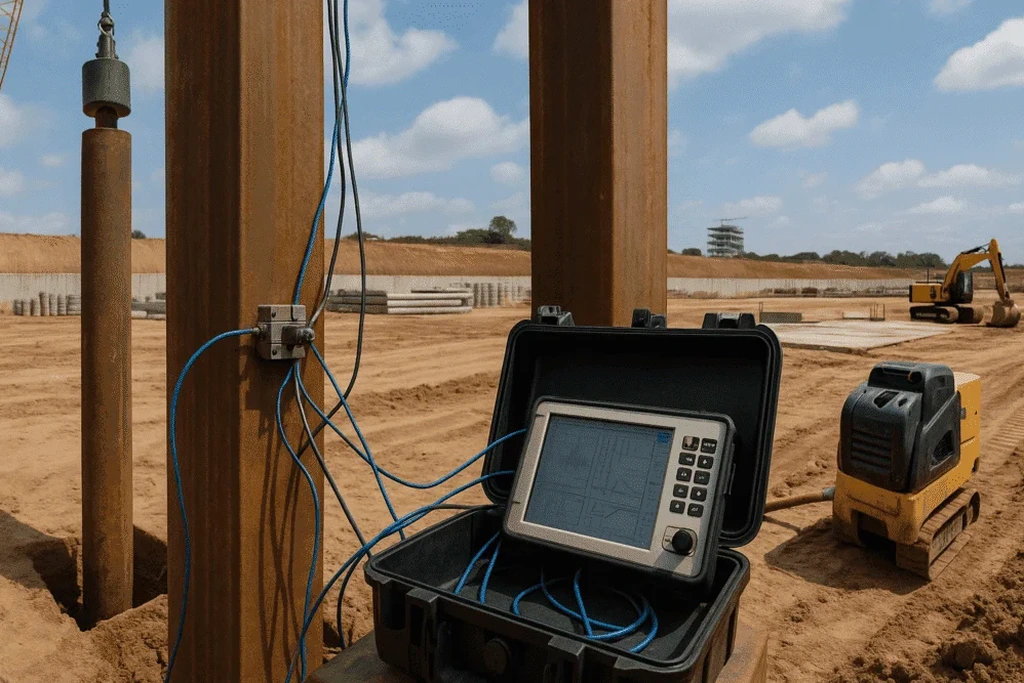
Soft alluvial soils in Baton Rouge can amplify earthquake motions by 2 to 3 times compared to rock sites.
Method and coverage
- Vs30 measurement via MASW or ReMi
- Site class determination per ASCE 7 Table 20.3-1
- 1D SHAKE-style response analysis for critical structures
Regional considerations
Baton Rouge grew rapidly along the Mississippi River levees. Many neighborhoods were built on filled swamps and old river channels. These areas contain soft compressible clays and loose silty sands. During an earthquake, these soils can amplify shaking and also liquefy. We have seen cases where differential settlement followed moderate seismic events elsewhere in the Mississippi embayment. Our analysis identifies zones where amplification is highest. We also evaluate liquefaction triggering using the NCEER method. For sites near the river, we recommend pairing seismic analysis with a licuefaccion study to cover both hazards.
Standards that apply
ASCE 7-22 (Minimum Design Loads, Chapter 20 – Site Classification), IBC 2021 (International Building Code, Section 1613), ASTM D4428/D4428M (MASW testing for vs30/" data-interlink="1">shear wave velocity), NEHRP Recommended Provisions (FEMA P-1050)
Associated technical services
MASW / Vs30 Surveys
Multi-channel analysis of surface waves to measure vs30/" data-interlink="1">shear wave velocity profiles. We determine Vs30 for site classification.
1D Seismic Response Analysis
Equivalent-linear or nonlinear site response modeling using SHAKE or DEEPSOIL. Outputs include acceleration time histories and response spectra.
Site-Specific Design Spectra
Development of design response spectra per ASCE 7 Chapter 21. We adjust spectral accelerations for local soil effects.
Liquefaction and Amplification Combined Study
Integrated analysis covering both ground shaking amplification and liquefaction triggering. We use SPT/CPT data and cyclic resistance ratios.
Typical parameters
Common questions
What is the typical site class for Baton Rouge soils?
Most of Baton Rouge falls into Site Class D (stiff to soft soil) per ASCE 7. Vs30 values range from 180 to 360 m/s. Near the Mississippi River, soft clays may push the site toward Class E. We confirm this with field measurements.
How much does a seismic amplification analysis cost in Baton Rouge?
A standard analysis for a single building site typically ranges from US$950 to US$2,280. This includes MASW survey, Vs30 calculation, and 1D response analysis. Larger projects or multiple profiles increase the cost.
Do I need a site-specific analysis for a small residential project?
IBC 2021 requires site-specific ground motion procedures for structures on Site Class E or F, or for Risk Category III/IV buildings. For typical homes on Site Class D, the code-default coefficients apply. But if your lot has soft clay or loose sand, an analysis can save money by avoiding over-design.