Building near the Mississippi River in Baton Rouge means dealing with soft alluvial clays and silty sands that behave very differently from the stiff Pleistocene soils found north of I-12. A high-rise foundation in the CBD requires CPT soundings to map thin sand lenses and clay layers that SPT alone would miss. The continuous cone penetration test gives us a real-time profile of soil behavior, tip resistance, and sleeve friction every centimeter. This is the difference between a foundation designed on averages and one tuned to actual stratigraphy. Before we drive piles or design mats, we run CPT soundings to identify bearing layers and weak zones. For sites near the river, we often combine CPT with liquefaction assessment to evaluate cyclic softening potential during seismic events.
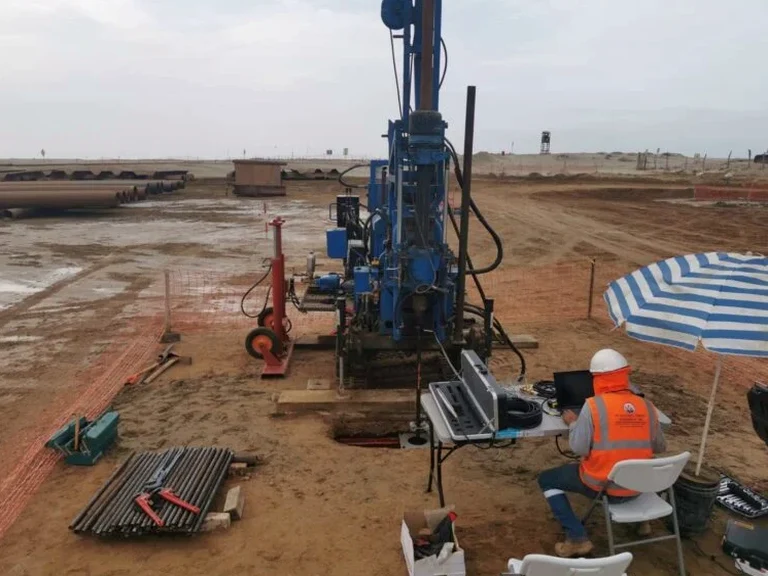
CPT data every 2 cm reveals thin clay seams and sand lenses that SPT intervals miss entirely — a critical advantage in Baton Rouge's layered delta soils.
Method and coverage
- Tip resistance (qc) — identifies bearing layers and compaction state of sands
- Sleeve friction (fs) — distinguishes clay from silt and sand
- Pore pressure (u2) — detects drainage conditions and identifies sensitive clays
Regional considerations
The CPT truck itself is a 20-ton rig that must reach the test location without getting stuck in soft ground. In Baton Rouge, that means planning access routes and sometimes using timber mats to spread the load on wet clay. We have seen projects where the rig sank during setup because the bearing capacity was below 1 ton per square foot. This is not a theoretical risk — it happens. Once the cone pushes, the main hazard is encountering a gravel layer that damages the tip. We monitor thrust and pore pressure in real time to stop before damage occurs. The biggest risk is misinterpreting thin sand lenses as bearing layers when they are actually loose and prone to liquefaction. That is why we always cross-check with seismic dilatometer data when in doubt.
Process video
Standards that apply
ASTM D5778-20 (Standard Test Method for Electronic Friction Cone and Piezocone Penetration Testing of Soils), ASCE 7-22 (Minimum Design Loads for Buildings, Section 11.4 — Site Class Determination via CPT), IBC 2021 (Chapter 18 — Geotechnical Investigation Requirements Incorporating CPT Data)
Associated technical services
Piezocone (CPTu) with Dissipation Tests
Pore pressure measurements during penetration plus dissipation tests at selected depths to estimate in-situ permeability and consolidation characteristics. Critical for soft clay sites near Capital Lake or the Comite River.
Seismic CPT (SCPT)
Cone equipped with geophones to measure vs30/" data-interlink="1">shear wave velocity (Vs) at each meter. Used for site class per ASCE 7 and liquefaction triggering analysis in Baton Rouge's Mississippi River alluvium.
Typical parameters
Common questions
What is the main advantage of CPT over SPT in Baton Rouge soils?
CPT gives continuous data every 2 cm, so thin sand lenses and clay seams are visible. SPT samples every 150 cm and can miss critical layers. In Baton Rouge's delta soils, those thin layers control liquefaction potential and differential settlement.
How deep can CPT soundings reach in Baton Rouge?
Typically 30 to 50 meters depending on soil conditions. The cone can penetrate stiff clay layers up to 25 MPa tip resistance. In the Mississippi River alluvium, we often reach 40 m before refusal or rod buckling.
Can CPT data be used for liquefaction assessment?
Yes. CPT-based liquefaction triggering methods (Robertson & Wride 1998, Idriss & Boulanger 2008) are standard. We use tip resistance and friction ratio to classify soils and compute cyclic resistance ratio (CRR). This is common for Baton Rouge projects near the river.
How much does a CPT sounding cost in Baton Rouge?
Between US$180 and US$240 per sounding point depending on depth, access conditions, and whether dissipation tests are included. Volume discounts apply for multiple soundings on the same site.
What soil types cause CPT refusal in Baton Rouge?
Dense sand and gravel layers with tip resistance above 25 MPa can cause refusal. We also encounter cemented layers (ironstone or caliche) in Pleistocene terrace deposits north of the city. Pre-drilling may be needed.