Much of Baton Rouge is underlain by the Mississippi River alluvial plain, which means soft clays, silts, and loose sands extend well below the surface. Groundwater sits within a few feet of grade across most of the city, from the Garden District to industrial corridors along the river. For any retaining wall project — whether a residential basement or a commercial loading dock — that combination of low-strength soils and shallow water drives the design. Before we finalize lateral earth pressures or drainage details, we run a site investigation that typically includes test pits to verify soil layering and a SPT boring to measure blow counts at depth. Without that data, the wall design is guesswork.
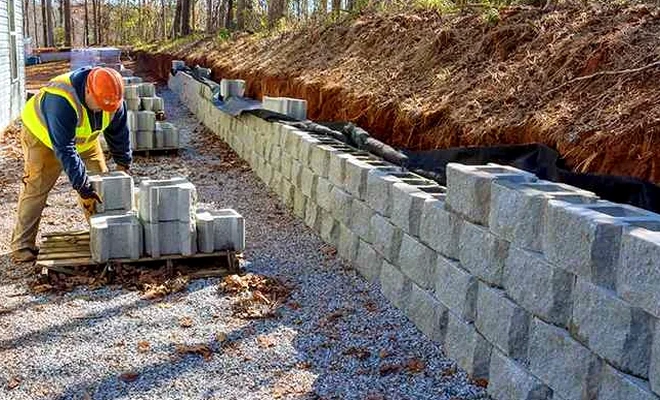
Shallow groundwater and soft alluvial clays in Baton Rouge mean wall drainage and global stability govern the design, not just the wall section.
Method and coverage
Regional considerations
Baton Rouge expanded rapidly after the 1950s, with subdivisions and commercial zones built on drained swampland and former agricultural fields. Those areas often contain undocumented fills, buried organic layers, and relic drainage ditches. A retaining wall built without verifying the subsurface can settle differentially or rotate into the excavation as the soft clay consolidates under its own weight. We have seen walls fail because the backfill drainage was omitted or because the wall was designed for drained conditions when the soil remained saturated. The biggest risk is global stability: a 10-foot wall on Baton Rouge clay can trigger a deep-seated rotational slide that extends well beyond the wall footprint.
Standards that apply
AASHTO LRFD Bridge Design Specifications (9th Ed., 2020) – Section 11, IBC 2021 – Chapter 18 (Soils and Foundations), ASCE 7-22 – Seismic lateral earth pressures, ASTM D1586-18 (SPT), ASTM D4318-17 (Atterberg limits)
Associated technical services
Cantilever and Gravity Wall Design
Reinforced concrete cantilever walls and gravity walls (crib, gabion, or mass concrete) for heights up to 15 feet. We size the base and stem based on lateral earth pressures from the site-specific soil parameters, include a heel drain system to relieve hydrostatic pressure, and verify bearing capacity against the low-strength Baton Rouge clays. Seismic loads are added per IBC 2021 for site class D or E.
Mechanically Stabilized Earth (MSE) Walls
For walls taller than 12 feet or where space is limited, we design MSE walls with steel or geosynthetic reinforcement. We select the backfill material (typically granular with less than 5% fines) and calculate the pullout resistance and internal stability per AASHTO LRFD. The system is especially effective in Baton Rouge because it spreads the load over a wider footprint, reducing bearing pressure on the soft alluvial soils.
Typical parameters
Common questions
What is the typical cost range for a retaining wall design in Baton Rouge?
For a residential or small commercial wall, the geotechnical design and report typically ranges from US$1.140 to US$4.150, depending on wall height, site access, and the number of borings required. This includes soil testing, stability analysis, and a stamped report. Larger projects with multiple walls or complex loading will be on the higher end.
Why is groundwater so critical for retaining walls in Baton Rouge?
Shallow groundwater — often less than 3 feet deep — creates hydrostatic pressure behind the wall. If the drainage system is undersized or clogged, that pressure can double the lateral load. In Baton Rouge, the low permeability of the clay means water drains slowly, so we always design for a saturated backfill condition and include a gravel drain or geocomposite drain behind the wall.
Do I need a geotechnical report for a retaining wall less than 4 feet high?
For walls under 4 feet with no surcharge and no slope above, the IBC allows prescriptive design without a full report. However, in Baton Rouge, even a short wall can experience differential settlement if built on undocumented fill or soft clay. A limited investigation with a test pit and a few hand auger borings is inexpensive and can prevent a leaning wall a few years later.
How do seismic loads affect retaining wall design in Baton Rouge?
Baton Rouge is in seismic design category B per IBC 2021, but the soft soils (site class D or E) amplify ground motion. ASCE 7-22 requires a seismic lateral earth pressure increment calculated using the Mononobe-Okabe method. For a 10-foot wall, this can add 20-30% to the required base width. We always include seismic loading in our stability checks, even for walls that would be considered 'low hazard.'