Baton Rouge sits on the Mississippi River's alluvial plain, where the top 30 to 50 meters consist of soft clays, silts, and sands deposited over thousands of years. Below that lie the Pleistocene terraces and Miocene-aged formations. This layered geology makes seismic tomography (refraction/reflection) a critical tool for understanding subsurface conditions. We deploy 24-channel seismographs and geophone arrays along lines up to 200 meters long to generate velocity profiles. These profiles reveal depth to bedrock, identify buried channels, and detect voids. Before we begin any survey, we review existing boring logs and may also recommend a MASW Vs30 to correlate shear-wave velocities with site class. The method is non-invasive, which matters in developed areas like downtown or near the LSU campus.
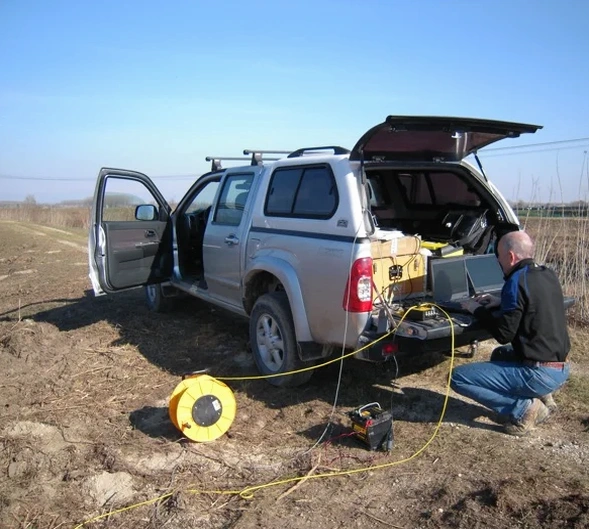
In Baton Rouge, seismic tomography reveals the sharp contrast between soft Holocene sediments and the stiff Pleistocene terrace, a boundary that controls foundation design.
Method and coverage
- Deploy 24 geophones at 3-meter spacing along a 69-meter spread
- Generate P-wave energy with a 8-kg sledgehammer on a steel plate
- Record S-waves using a horizontally polarized hammer strike on a shear-wave beam
- Process data using refraction tomography algorithms (refraction) and CMP stacking (reflection)
We also integrate results with georradar GPR for shallow utility mapping and with downhole seismic when higher vertical resolution is needed. The final product is a 2D velocity section showing layers from the surface down to 30–40 meters depth. This helps engineers design foundations for the soft-soil conditions common in the Red Stick area.
Regional considerations
ASCE 7-22 requires site classification based on average shear-wave velocity in the top 30 meters (Vs30). For Baton Rouge, this is especially critical because the Mississippi River alluvium often falls into Site Class D (stiff soil) or E (soft soil). A misclassified site can lead to under-designed foundations or, worse, resonance issues during seismic events. Seismic tomography provides the velocity profiles needed to assign the correct site class. We also cross-reference results with the response sismica study for dynamic analysis of tall structures. Using wrong velocity values can double the design lateral load. That risk is real, and it is avoidable with proper testing.
Standards that apply
ASTM D5777-18 (Standard Guide for Refraction Seismic), ASTM D7128-18 (Standard Guide for Reflection Seismic), ASCE 7-22 (Minimum Design Loads, Site Class from Vs30)
Associated technical services
Refraction Tomography for Shallow Bedrock Mapping
Designed for sites where the target depth is 10–30 meters. We generate P-wave velocity models that detect the top of the Pleistocene terrace or the Miocene sandstone, which acts as bearing stratum for deep foundations. The method works well in open fields, along levee alignments, and in industrial areas. We provide a velocity contour map and interpreted layer depths at every geophone station.
Reflection Seismic for Deep Stratigraphy and Fault Detection
When the target depth exceeds 30 meters or when you need to identify subtle changes in stratigraphy, we switch to reflection processing. Using Common Midpoint (CMP) stacking, we image deeper interfaces and can detect buried faults or paleochannels. This service is common for bridge foundations, port facilities, and large-diameter water transmission lines in the greater Baton Rouge area.
Typical parameters
Common questions
How much does a seismic tomography survey cost in Baton Rouge?
A standard refraction tomography survey for a 69-meter line typically ranges between US$2,340 and US$5,460, depending on site access, number of lines, and whether you need both P-wave and S-wave data. Reflection processing adds about 30% more.
What is the difference between refraction and reflection tomography?
Refraction uses first-arrival times of waves that travel along layers, giving velocity versus depth. It is best for mapping shallow interfaces (top of bedrock, water table). Reflection uses later arrivals that bounce off deeper interfaces, so it images deeper stratigraphy and can detect faults. We often run both on the same dataset.
Do I need seismic tomography if I already have SPT borings?
SPT borings give point data every 1.5 meters. Tomography provides a continuous velocity section between boreholes, so you can interpolate layers confidently. It also gives Vs30 for site classification per ASCE 7, which SPT alone does not. For large projects, we recommend combining both methods.
How long does a field survey take?
For a single 69-meter line with 24 geophones, field work takes about 4 hours including setup, shooting, and demobilization. Multiple lines or longer spreads add time proportionally. Processing and reporting usually take 5 to 10 business days depending on complexity.
What is the maximum depth you can image with this method?
In Baton Rouge's soft soils, we reliably image down to about 40 meters with a 69-meter spread. If you need greater depth, we extend the array to 115 meters (48 geophones) to reach 60–70 meters. The trade-off is lower shallow resolution. We discuss the best geometry during the planning call.