Baton Rouge expanded fast along the Mississippi floodplain after the 1950s petrochemical boom. Developers filled swamps with sand and silty clay before building. That fill is loose. It settles under load. A warehouse or tank farm on untreated ground can sink unevenly within months. Our team applies dynamic compaction design to densify those deep deposits. We drop a heavy weight from controlled heights. The impact drives particles closer together. Before we start, we run a MASW survey to map velocity layers and a CPT sounding for continuous resistance profiles. The data tells us the energy needed per drop point. We then design the grid spacing and tamper mass for Baton Rouge specific conditions. The result is a foundation bed that meets post-treatment bearing criteria without piling.
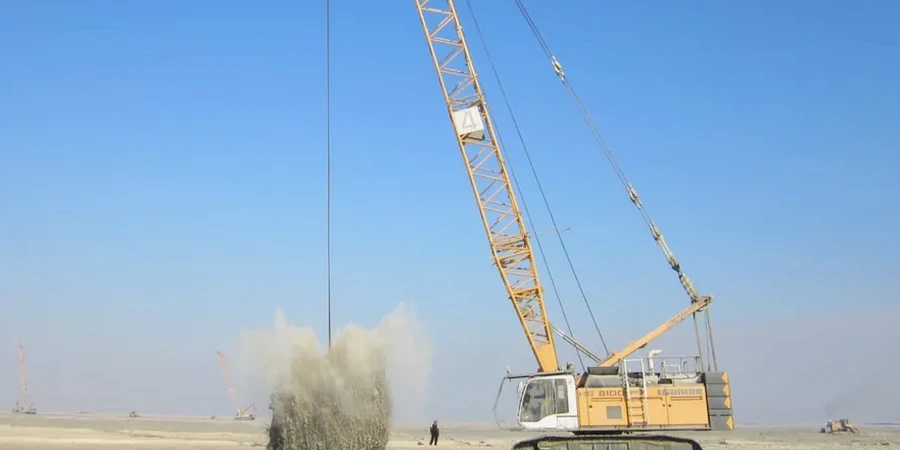
Surface rollers treat the top meter. Dynamic compaction treats the top fifteen. That is the difference between a slab that cracks and one that stays level.
Method and coverage
Regional considerations
Compare the Garden District with the industrial corridor along River Road. The Garden District sits on Pleistocene terraces stiff clay with high bearing capacity. River Road sites sit on Holocene alluvium soft silt and loose sand to 20 meters depth. If you apply the same foundation design in both zones, the industrial site fails. Dynamic compaction design bridges that gap. We densify the loose strata so the soil behaves like a stiffer deposit. Without it, the risk is uncontrolled settlement, liquefaction susceptibility during a design seismic event, and long-term maintenance costs that erase the initial savings of skipping Improvement.
Standards that apply
ASCE 7-22 (Chapter 20: Site Classification for Seismic Design), ASTM D1586-18 (Standard Test Method for Standard Penetration Test), FHWA NHI-16-072 (Improvement Methods, Volume II)
Associated technical services
Pre-treatment Site Investigation
Borings, CPT, and MASW to characterize stratigraphy and soil strength before the drop program. We identify loose zones and soft layers that require higher energy or additional drainage.
Energy Calculation and Grid Layout
Finite element modeling to determine tamper mass, drop height, spacing, and number of passes. Output includes a drop sequence plan that minimizes rework and maximizes depth of improvement.
Post-treatment Verification Testing
CPT and plate load tests at planned locations to confirm that bearing capacity and relative density meet project specifications. We issue a signed report with as-built energy records.
Typical parameters
Common questions
What soil conditions in Baton Rouge require dynamic compaction design?
Loose sands, silty sands, and uncontrolled fills deeper than 4 meters are the primary candidates. The Mississippi alluvium here often has relative densities below 50% at depth, which causes excessive settlement under structural loads. Dynamic compaction raises relative density to 70% or higher.
How does the high water table in Baton Rouge affect the drop program?
The water table sits 1.5 to 3 meters below grade across most of East Baton Rouge Parish. Saturated soils dissipate impact energy differently. We account for this by increasing drop height and reducing spacing in the saturated zone. We also monitor pore pressure buildup and allow rest periods between passes.
What is the typical depth of improvement achieved with dynamic compaction design in local projects?
We consistently achieve 8 to 12 meters of improvement in Baton Rouge alluvial fills. With heavier tampers (25 to 30 tons) and high drops, the depth can reach 15 meters. The actual value depends on soil type, energy input, and the number of passes.
Can dynamic compaction be used near existing structures or pipelines in Baton Rouge?
Yes, but with strict vibration monitoring. We set peak particle velocity limits at 50 mm/s for typical industrial structures and 25 mm/s for sensitive equipment. We pre-excavate a vibration trench or use a reduced energy sequence near the boundary. The design adapts to site constraints.