Baton Rouge sits on an average elevation of just 56 feet above sea level, and beneath its surface lies a thick deposit of Pleistocene-age alluvial clays and silts that shift with every change in moisture content. For any construction project in this city, the difference between a stable slab and a cracked foundation often comes down to whether the subgrade has been chemically treated. We apply lime and cement stabilization to transform those problematic clays into a workable, load-bearing platform. Before mobilizing the spreader, our team runs a full set of Atterberg limits and pH tests to determine which additive — quicklime, hydrated lime, or Type I/II Portland cement — will react best with the local soil. The result is a treated layer that meets the design CBR and reduces plasticity index by 40 to 60 percent, cutting the risk of differential movement under the structure.
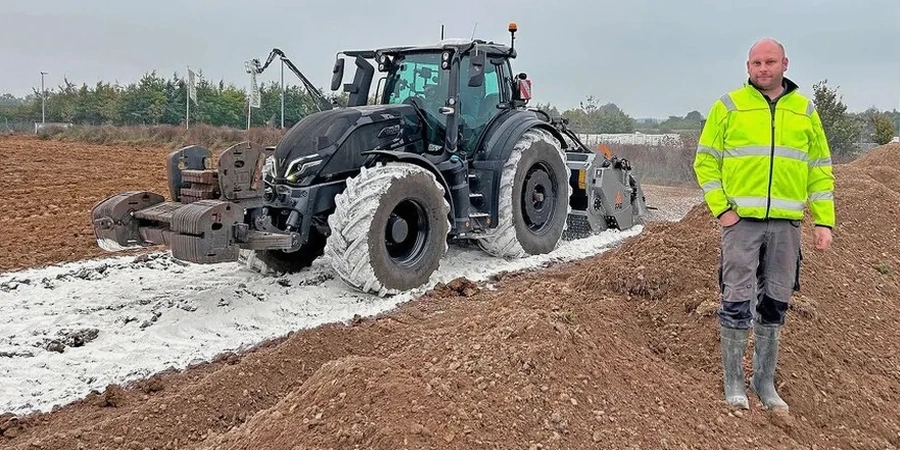
Proper lime or cement stabilization can reduce the plasticity index of Baton Rouge clays by 40 to 60 percent, cutting differential movement risk significantly.
Method and coverage
Regional considerations
The dominant soil type across most of Baton Rouge is a highly plastic clay classified as CH under the Unified Soil Classification System, with liquid limits often exceeding 70 and plasticity indices in the 35 to 55 range. These clays shrink and swell dramatically with seasonal rainfall, which averages about 62 inches per year in the city. Without chemical stabilization, a conventional slab-on-grade built on untreated CH clay can experience differential heave exceeding one inch within the first two years. The groundwater table fluctuates between 5 and 15 feet below grade, but perched water in the clay layers can keep the subgrade saturated for weeks after heavy rain. We address this risk by specifying a stabilization depth of 12 to 18 inches, ensuring that the active zone of moisture change is fully treated before any foundation or pavement is placed on top.
Standards that apply
ASTM D6276 (Standard Test Method for Using pH to Estimate the Soil-Lime Proportion Requirement), ASTM D1633 (Compressive Strength of Molded Soil-Cement Cylinders), ASTM D4318 (Atterberg Limits) — used to verify PI reduction after treatment, ASTM D1557 (Modified Proctor) — compaction control for treated soils
Associated technical services
Lime Stabilization for Expansive Clays
We apply quicklime or hydrated lime to high-plasticity clays to reduce moisture sensitivity and shrink-swell potential. The process includes mixing to a depth of 12 to 18 inches, mellowing for 24 to 48 hours, and final compaction to 95% of modified Proctor density.
Cement Stabilization for Increased Strength
For projects requiring higher early bearing capacity — such as industrial floors or roadway subbase — we blend Portland cement (Type I or II) at 4% to 8% by dry weight. The treated layer achieves unconfined compressive strengths of 200 to 500 psi within seven days and is ready for overlying construction with minimal delay.
This service complements our laboratory testing work for a complete project analysis.
Typical parameters
Common questions
How do I know whether my Baton Rouge soil needs lime or cement stabilization?
The choice depends on the plasticity index and the target strength. If the PI exceeds 25 and the main concern is swell control, lime is usually the better option because it reacts chemically with clay minerals to reduce plasticity. If you need a faster strength gain for load-bearing layers, cement is preferred. Our lab runs Atterberg limits and pH tests to recommend the right additive and dosage.
What is the typical cost range for lime or cement stabilization in Baton Rouge?
For a standard stabilization depth of 12 to 18 inches, the total cost including material, mixing, compaction, and quality control testing typically falls between US$770 and US$2,140. The variation depends on the volume of soil to be treated, the additive type and dosage, and whether site access requires mobilization of specialized equipment.
How long does the treated soil take to cure before construction can continue?
Cement-stabilized soil typically reaches adequate strength after 7 days of moist curing. Lime-stabilized soil requires a longer curing period — usually 14 to 28 days — because the pozzolanic reaction between lime and clay minerals develops more slowly. We perform field density checks and unconfined compression tests to confirm the layer is ready before any structural loading is applied.