The Mississippi River has shaped Baton Rouge’s geology for millennia, leaving behind a layered sequence of silty clays, sands, and organic-rich deposits that vary dramatically within a few hundred meters. This alluvial legacy means permeability can shift from 10⁻⁴ cm/s in a clay lens to 10⁻² cm/s in a sandy channel — a range that makes infiltration testing essential for any project involving stormwater infiltration, septic system design, or green infrastructure. We run double-ring infiltrometer tests following ASTM D3385, complemented by the Porchet method for shallower investigations, to capture the actual field-saturated hydraulic conductivity of the soil profile. A thorough infiltration test reveals how the native ground will behave under sustained ponding, which directly influences the sizing of rain gardens, retention basins, and drainfields. In areas where shallow groundwater is present, we also coordinate with drenaje geotécnico to ensure the system won't saturate the subgrade over time.
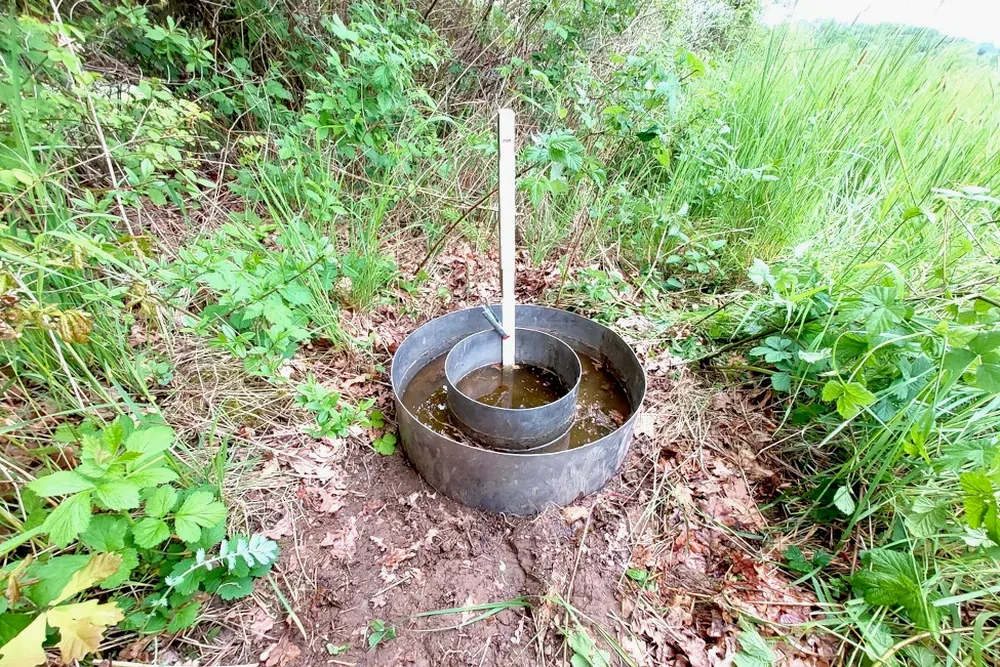
In Baton Rouge, a single infiltration test can reveal permeability differences of two orders of magnitude within the same lot — that's the reality of Mississippi River alluvium.
Method and coverage
- Double-ring infiltrometer (ASTM D3385-18) for reliable field-saturated conductivity at depths up to 60 cm
- Porchet method for rapid assessment in shallow pits or when access is limited
- Pre-test site characterization via test pits to identify soil layers and groundwater depth
- Correlation with grain size distribution for preliminary permeability estimates
Regional considerations
Consider two typical Baton Rouge sites: a lot near the Comite River where sandy loam dominates, versus a property in the Sherwood Forest area underlain by fat clay (CH). The first may yield infiltration rates above 2 in/hr, while the second can drop below 0.1 in/hr. If you size a stormwater basin based on the sandy loam assumption without a proper infiltration test, you risk chronic ponding, mosquito breeding, and eventual system failure in the clay zone. We've seen subdivision drainage plans rejected by East Baton Rouge Parish because designers relied on published soil surveys instead of field measurements. A double-ring infiltrometer test at each proposed infiltration location eliminates that guesswork and gives permitting authorities the site-specific data they require.
Standards that apply
ASTM D3385-18 (Standard Test Method for Infiltration Rate of Soils in Field Using Double-Ring Infiltrometer), ASTM D5092-04 (Standard Practice for Design and Installation of Groundwater Monitoring Wells), IBC 2021 Chapter 18 (Soils and Foundations) – infiltration requirements for stormwater management
Associated technical services
Double-Ring Infiltrometer Testing
We conduct ASTM D3385-18 double-ring infiltrometer tests at depths up to 60 cm with constant-head ponding. The inner ring measures vertical infiltration while the outer ring prevents lateral divergence. Results include field-saturated hydraulic conductivity (Kfs) and cumulative infiltration curves, reported in both cm/s and in/hr for direct use in drainage design.
Porchet Infiltration Test (Shallow Pit Method)
For rapid assessments in shallow excavations or where access is restricted, we use the Porchet method. A cylindrical pit is dug to the target depth, filled with water, and the falling head is recorded over time. This method works well for evaluating infiltration at the base of rain gardens, dry wells, or septic drainfields. We correlate results with soil texture and bulk density for a complete picture.
This service complements our laboratory testing work for a complete project analysis.
Typical parameters
Common questions
What is the difference between double-ring infiltrometer and Porchet test?
The double-ring infiltrometer isolates vertical flow by using an outer buffer ring to suppress lateral divergence, making it more accurate for measuring field-saturated hydraulic conductivity. The Porchet test is simpler and faster — it uses a single pit with falling head — but can overestimate infiltration if lateral flow is significant. In Baton Rouge's layered soils, we often run both methods to compare results and select the most representative value for design.
How much does an infiltration test cost in Baton Rouge?
A typical double-ring infiltrometer test in Baton Rouge ranges between US$370 and US$460 per test location, including mobilization for a single site. The Porchet method is usually slightly lower, around US$300 to US$380. These rates cover field setup, two to six hours of testing, data reduction, and a certified report. Volume discounts apply for multiple test points on the same property.
What site conditions affect infiltration test results in Baton Rouge?
Baton Rouge's alluvial soils are highly variable. Clay content, compaction from construction traffic, shallow groundwater, and the presence of organic layers all influence measured infiltration rates. A test performed after a dry spell may show higher rates than one done after heavy rain, because antecedent moisture conditions affect the soil's ability to absorb water. We always record soil moisture and note any visible soil features in the report.
How long does it take to get infiltration test results?
Field testing typically takes two to six hours per location, depending on soil permeability — slower soils require longer ponding to reach steady state. We deliver the final report with raw data, calculated Kfs, and infiltration curves within three to five business days after testing. For urgent projects, expedited turnaround in 24 hours is available at an additional charge.