The hydraulic hammer rests on the lead, ready to drive the first steel pile into the Mississippi River alluvium. In Baton Rouge, the soil profile typically consists of soft to medium stiff clays overlying dense sands and gravels at depth. Our team uses a diesel hammer system with a 5-ton ram to advance test piles to refusal or to the design tip elevation. Before driving, we review existing borehole logs and cross-check them with a study of SPT to correlate blow counts with soil stratigraphy. This direct approach gives us real-time feedback on pile resistance during installation.
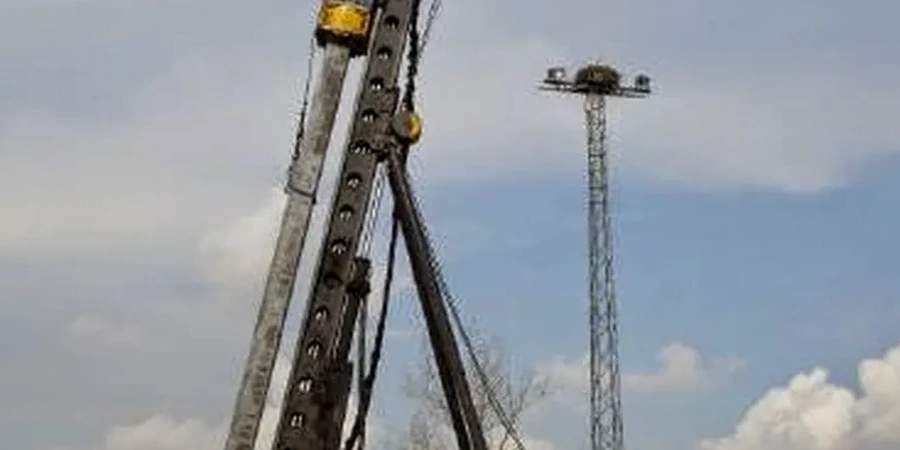
Dense Pleistocene sands at 40 to 60 feet provide end-bearing capacity for driven piles in Baton Rouge, but clay plugging and setup effects require site-specific calibration.
Method and coverage
- Wave equation analysis (GRLWEAP) to predict driving stresses and hammer performance.
- Static capacity calculation using the alpha method for side friction in clay layers.
- Pile load test verification with ASTM D1143 quick load test procedure.
Regional considerations
A 15-story tower near the Mississippi River levee required driven piles to support 3,500-kip column loads. The geotechnical report indicated sand at 55 feet. During driving, the pile encountered a stiff clay layer at 30 feet that caused refusal at only 42 feet. The hammer energy was insufficient to penetrate the clay. We performed a restrike after 24 hours and measured 30% setup gain. Without this data, the foundation would have been under-designed for long-term settlement under sustained loads.
Standards that apply
IBC 2021 – Chapter 18 (foundations and piles), ASCE 20-96 – Standard for design of steel piles, ASTM D4945-17 – High-strain dynamic testing of piles, ASTM D1143/D1143M-07 – Standard test method for piles under static axial compressive load
Associated technical services
Pre-construction pile analysis and drivability study
We review existing soil borings, perform wave equation analysis, and recommend pile type, length, and hammer size. The study includes driving stress predictions and capacity estimates using local soil data from the Baton Rouge area.
Dynamic pile testing and CAPWAP analysis
During pile installation, we attach strain gauges and accelerometers to measure force and velocity. We then run CAPWAP signal matching to back-calculate static capacity and soil resistance distribution, verifying the design assumptions.
Typical parameters
Common questions
What is the typical pile capacity in Baton Rouge clay and sand layers?
In the soft to medium stiff clays of the Mississippi River floodplain, side friction ranges from 0.5 to 1.2 ksf. The dense Pleistocene sands at depth provide end-bearing capacity of 80 to 150 ksf. Combined ultimate capacity for a 12-inch pipe pile driven to 50 feet is typically between 200 and 450 kips, depending on layer thickness and soil sensitivity.
How much does driven pile design cost in Baton Rouge?
The cost for a full driven pile design package including drivability study and CAPWAP analysis typically ranges between US$1,280 and US$4,240. This covers site-specific analysis, wave equation modeling, and on-site dynamic testing. Volume discounts apply for multiple pile types or large projects.
What causes pile refusal in Baton Rouge soils?
Refusal often occurs when a dense sand or gravel layer is encountered at shallow depth, or when a stiff clay layer with high undrained shear strength is present. In Baton Rouge, the most common cause is a 10- to 15-foot thick stiff clay layer at 25 to 35 feet that requires high driving energy. If the hammer energy is insufficient, the pile may refuse prematurely, requiring a larger hammer or predrilling.
When should I use dynamic testing instead of a static load test?
Dynamic testing (PDA with CAPWAP) is recommended for projects with multiple piles of the same type and length. It provides capacity data for every pile tested, not just one, and costs less than a static load test. Use static load tests only when the design requires proof of capacity for a single pile or when local building officials mandate it. In Baton Rouge, dynamic testing is accepted by most jurisdictions when calibrated to a static test.