Foundation engineering in Baton Rouge represents a critical discipline that addresses the complex interaction between structures and the challenging subsurface conditions characteristic of southern Louisiana. The capital city's foundation requirements encompass everything from initial settlement analysis to advanced deep foundation solutions, ensuring buildings remain stable despite the region's notoriously difficult soils. Proper foundation design here is not merely a structural consideration but a fundamental necessity driven by the Mississippi River alluvial plain geology, high water tables, and the persistent threat of differential settlement that has plagued improperly designed structures throughout the city's history.
Baton Rouge sits atop Pleistocene-age terrace deposits and recent Holocene alluvium from the Mississippi River, creating a complex stratigraphy of interbedded clays, silts, and sands with highly variable engineering properties. The area's most significant geotechnical challenge stems from the expansive fat clays of the Port Hudson formation, which exhibit substantial shrink-swell behavior with moisture content fluctuations. Combined with shallow groundwater tables typically ranging from 3 to 10 feet below grade and the region's average annual rainfall exceeding 60 inches, these conditions demand rigorous expansive soil evaluation as a prerequisite for any foundation design process. The presence of soft, normally consolidated clays in many areas further complicates bearing capacity calculations and settlement predictions.
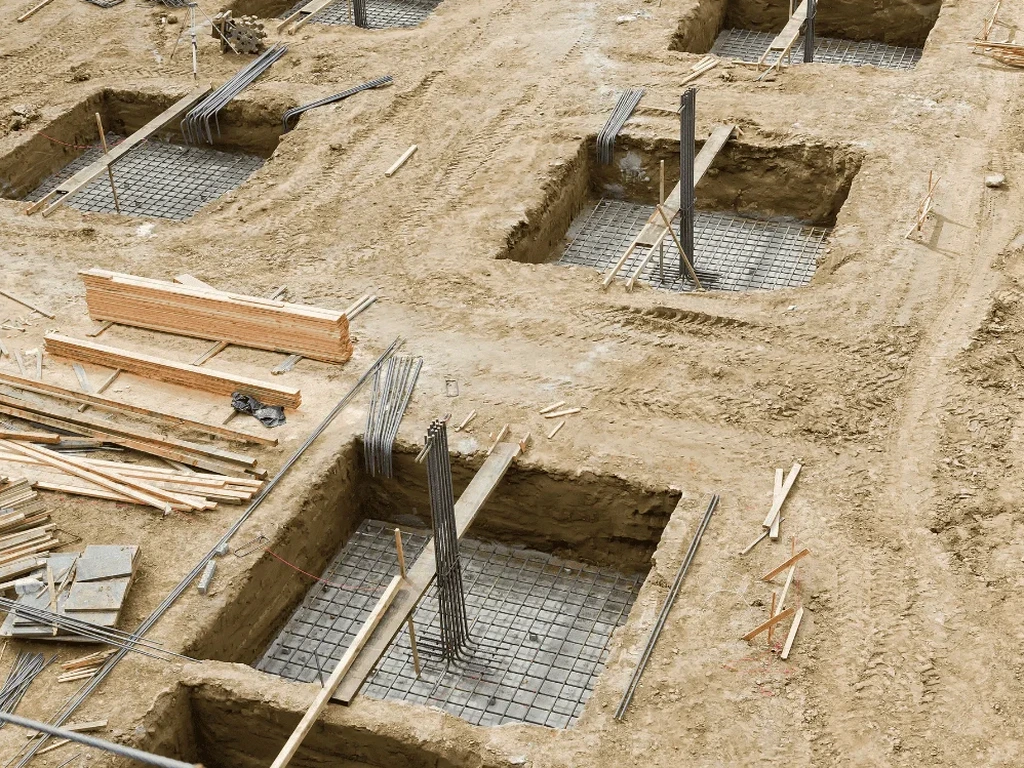
Regulatory compliance in Baton Rouge follows the Louisiana State Uniform Construction Code, which adopts the International Building Code with state-specific amendments addressing local geotechnical conditions. Foundation designs must satisfy Chapter 18 of the IBC for soils and foundations, while the Louisiana Department of Transportation and Development provides additional guidance for deep foundation testing and acceptance criteria through their standard specifications. The East Baton Rouge Parish building permit process requires geotechnical reports stamped by Louisiana-licensed professional engineers, with particular emphasis on expansive soil mitigation measures and flood zone considerations given the city's participation in the National Flood Insurance Program.
The range of projects requiring specialized foundation engineering spans from residential developments in suburban areas like Central and Zachary, where shallow foundation design must account for active clay soils, to major commercial and industrial facilities along the Mississippi River corridor requiring driven pile design for heavy structural loads. Institutional projects at Louisiana State University, healthcare facilities in the medical district, and infrastructure improvements throughout the I-10/I-12 corridor all demand foundation solutions tailored to site-specific conditions. The increasing frequency of mid-rise construction in downtown Baton Rouge has heightened the importance of seismic considerations, particularly given the region's proximity to the New Madrid Seismic Zone.
Available services
Common questions
What are the most common foundation problems in Baton Rouge?
The most prevalent foundation issues in Baton Rouge stem from expansive clay soils that shrink and swell with moisture changes, causing differential movement and cracking. High water tables complicate excavation and require dewatering during construction. Soft alluvial deposits lead to excessive settlement under load, while organic soils in low-lying areas can decompose and create voids. These conditions frequently manifest as sticking doors, wall cracks, and uneven floors in structures without proper foundation engineering.
When is a deep foundation necessary versus a shallow foundation in this region?
Deep foundations become necessary when near-surface soils lack adequate bearing capacity or when expansive clays pose unacceptable movement risks for the structure. In Baton Rouge, this commonly occurs with commercial buildings exceeding three stories, structures on soft alluvial deposits near waterways, and projects where settlement tolerances are tight. Shallow foundations may suffice for light residential construction on competent terrace deposits, provided expansive soil mitigation measures like moisture barriers and proper drainage are implemented.
How do local building codes address foundation design in Baton Rouge?
Local codes adopt the International Building Code with Louisiana amendments, requiring geotechnical investigations for all commercial and multi-family residential projects. Chapter 18 of the IBC governs allowable bearing pressures and settlement limits, while East Baton Rouge Parish mandates sealed foundation plans demonstrating compliance with flood zone requirements. The code specifically requires consideration of expansive soil conditions and allows engineered fill or deep foundation alternatives when native soils are unsuitable.
What role does soil testing play in foundation design for Baton Rouge projects?
Soil testing provides the essential parameters for foundation design by characterizing soil strength, compressibility, and expansiveness through laboratory and field methods. Standard penetration tests, cone penetrometer testing, and laboratory consolidation and swell tests quantify the engineering properties needed for bearing capacity and settlement calculations. Without comprehensive testing, foundation designs risk either costly over-conservatism or dangerous underestimation of soil behavior under structural loads, particularly given the variability of alluvial deposits across the Baton Rouge area.