The difference between building on the natural levee ridges along the Mississippi and the backswamp areas near the Comite River is night and day. In the Garden District, you get stiff clay that holds a vertical cut for days; head toward the lowlands off Airline Highway and you hit soft, saturated clay that barely holds together. That’s exactly where the unconfined compression test (UCS) earns its keep – it gives a fast, reliable snapshot of undrained shear strength for cohesive soils without the complexity of triaxial setups. For shallow foundation checks in Baton Rouge, this test often pairs with a complete soil classification to confirm the design parameters match the local geology.
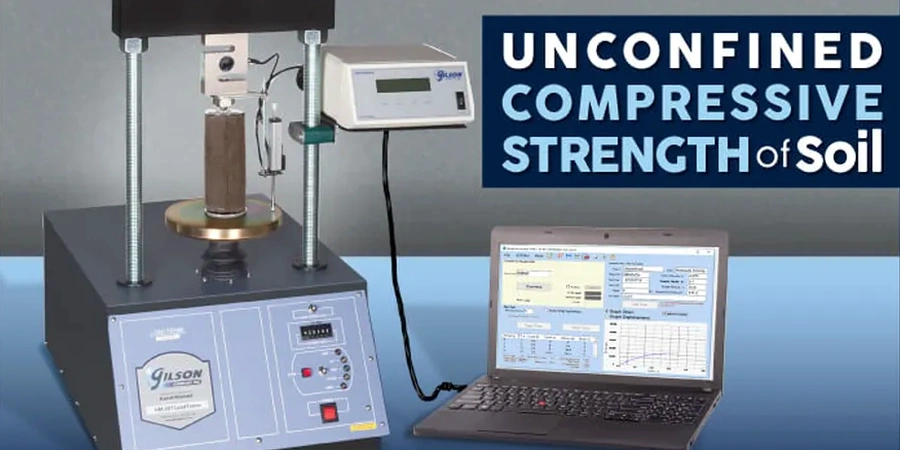
For Baton Rouge’s soft clays, the UCS test gives you a reliable undrained shear strength value in under fifteen minutes, straight from a Shelby tube.
Method and coverage
Regional considerations
The Mississippi River floodplain around Baton Rouge gets heavy spring rains that saturate the upper clay crust. If you run a UCS test on a sample that dried out during handling or sat too long in a hot truck, the strength reading will be artificially high. That’s a real risk – you might design a footing thinking you have 80 kPa of undrained strength when the wet-site value is closer to 40 kPa. The team always seals samples in wax or plastic immediately after extraction and tests them within 24 hours to preserve the in-situ moisture. Overlooking this step has led to differential settlement in several warehouse slabs along the I-10 corridor.
Process video
This service complements our laboratory testing work for a complete project analysis.
Standards that apply
ASTM D2166-16 – Standard Test Method for Unconfined Compressive Strength of Cohesive Soil, ASTM D1587-15 – Standard Practice for Thin-Walled Tube Sampling of Fine-Grained Soils, IBC 2021 Section 1803 – Geotechnical Investigations
Associated technical services
Thin-Walled Tube Sampling (Shelby Tubes)
Hydraulic push of 3-inch Shelby tubes per ASTM D1587 to recover undisturbed cohesive samples for the UCS test. Essential for accurate strength results.
Moisture Content & Unit Weight
Wet and dry density measurements on the same sample used for the UCS test, so you get the full picture: strength plus natural state.
Triaxial UU Test (Unconsolidated-Undrained)
When you need undrained strength at multiple confining pressures, the triaxial UU test provides a more complete failure envelope than the unconfined test alone.
Typical parameters
Common questions
How much does an unconfined compression test (UCS) cost in Baton Rouge?
The typical cost for a single UCS test in the Baton Rouge area ranges between US$360 and US$530, depending on whether you provide the Shelby tube sample or we handle the field extraction. Volume discounts apply for projects with multiple samples.
What kind of soil is suitable for the unconfined compression test?
The test is designed for cohesive, fine-grained soils – think silty clays, fat clays (CH), and lean clays (CL) that hold together without confinement. It does not work on sands, gravels, or dry, crumbly soils. Most of Baton Rouge's alluvial clay deposits fit the bill perfectly.
How quickly can I get the UCS results for a Baton Rouge project?
Since the test itself takes only 15 minutes per sample, we can usually deliver a preliminary strength value within 24 hours of receiving the undisturbed tube. A full report with moisture content and unit weight takes 2 to 3 business days.