Baton Rouge's soil profile shifts dramatically between the high bluffs along the Mississippi and the low-lying floodplains east of the river. In the Garden District, stiff Pleistocene clays support heavy loads with little settlement, while just a few miles south in the Sherwood Forest area, soft Holocene clays and organic silts dominate. Engineers planning foundations in those softer zones need a reliable method to measure undrained shear strength without disturbing the sensitive soil structure. That is where the field vane shear test comes in. It provides a direct, in-situ reading of peak and remolded shear strength, critical for slope stability analysis and foundation design in Baton Rouge's variable ground conditions. Before mobilizing heavy equipment, a quick VST can be paired with a calicatas exploratorias to confirm stratigraphy, or with an ensayo SPT when sand layers are suspected between clay beds.
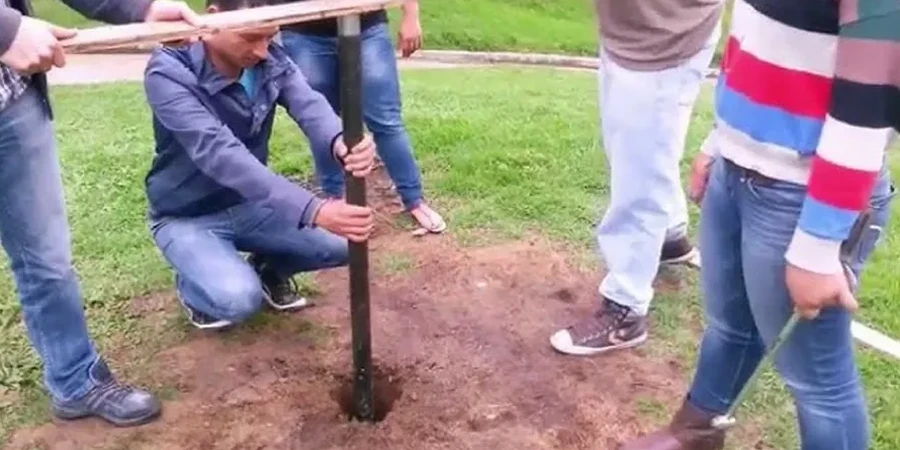
A single vane shear test can reveal whether that soft clay beneath your slab is stable at a factor of safety of 1.5 or needs Improvement.
Method and coverage
Regional considerations
A 10-story apartment complex near Bluebonnet Boulevard was planned with shallow footings based on borings that missed a 3-meter soft clay lens. During excavation, the subgrade pumped under construction traffic. A field vane shear test was run at the exact footing locations. The peak Su came in at 18 kPa, far below the design assumption of 40 kPa. The foundation had to be redesigned with deep piles, adding six weeks to the schedule. That scenario repeats across Baton Rouge whenever soft clay is overlooked. The VST is the fastest way to catch it before concrete is poured, reducing the risk of differential settlement and structural failure in the city's softest deposits.
Process video
Standards that apply
ASTM D2573-18 — Standard Test Method for Field Vane Shear Test in Saturated Fine-Grained Soils, ASTM D2487-17 — Standard Practice for Classification of Soils for Engineering Purposes, ASCE 7-22 — Minimum Design Loads and Associated Criteria for Buildings (clay strength correlations)
Associated technical services
Standard VST (ASTM D2573)
Full vane shear test at specified depths with peak and remolded readings. Includes torque calibration, depth verification, and field log.
Sensitivity & Remolded Strength Profile
Multiple VSTs along a borehole or at shallow grid points to build a sensitivity map. Critical for liquefaction and slope stability analyses.
VST with CPT Correlation
Combined vane shear and cone penetration test at the same location. CPT cone resistance is correlated to vane Su for continuous strength profiles.
Rapid VST for Construction QA/QC
On-demand VST during earthwork or foundation excavation to verify that exposed clay meets design shear strength before proceeding.
Typical parameters
Common questions
What is the difference between a field vane shear test and a triaxial test for soft clays in Baton Rouge?
The field vane shear test measures undrained shear strength in situ with minimal disturbance, which is ideal for soft, sensitive clays like those found in Baton Rouge's floodplain. A triaxial test requires undisturbed sampling, which can alter the clay structure. VST gives a direct peak and remolded reading; triaxial provides stress-strain behavior and effective strength parameters. Both are complementary, but VST is faster and avoids sample disturbance.
How much does a field vane shear test cost in Baton Rouge?
The typical cost for a field vane shear test in Baton Rouge ranges between US$690 and US$1,550 per test point, depending on depth, number of readings, and site access. Mobilization fees may apply for sites outside the metropolitan area.
At what depths and soil types is the vane shear test most reliable?
The vane shear test is most reliable in soft to firm clays and silts with Su less than 200 kPa, typically at depths from 1 to 30 meters. It is not recommended for stiff clays, sands, or gravels because the vane cannot penetrate or shear the soil properly. In Baton Rouge, the test is ideal for the Holocene clays found beneath the eastern parishes.