Garden District homes sit on firmer Pleistocene terraces, while the industrial corridor near the Mississippi backswamp deals with decades of soft alluvial clay. That contrast defines preloading with surcharge design in Baton Rouge. Downtown developments and petrochemical expansions both benefit from this staged loading technique, which mimics final structural loads to drive out pore water and reduce long-term settlement. The approach is especially effective given the 30 to 60 feet of soft clay that blankets much of the floodplain. Before designing a surcharge sequence, we integrate data from consolidation tests to estimate primary compression rates and secondary creep, tailoring the fill schedule to site-specific stratigraphy.
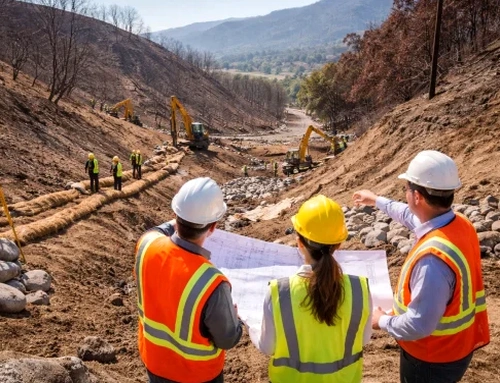
A surcharge 30 percent above final load can cut post-construction settlement by half in Baton Rouge soft clay, saving millions in future pavement repairs.
Method and coverage
Regional considerations
What catches many teams off guard in Baton Rouge is the secondary compression after the surcharge is removed. The organic alluvial clays here can exhibit creep rates of 0.5 to 1.5 percent per log cycle of time, even after primary consolidation finishes. We have seen projects where the surcharge was removed too early based on pore pressure readings alone, only to record another 6 inches of settlement over the next two years. That is why we always extend monitoring for at least three months after surcharge removal, and we recommend a suelos-organicos evaluation to quantify the organic fraction. Another issue is the lateral squeeze beneath the surcharge edges, which can shear foundation piles if not properly modeled.
Standards that apply
ASTM D2435 (One-Dimensional Consolidation), ASTM D4186 (Constant Rate of Strain Consolidation), FHWA NHI-05-037 (Embankment Design Manual), ASCE 7-22 (Minimum Design Loads)
Associated technical services
Consolidation Testing & Settlement Analysis
One-dimensional consolidation tests on undisturbed samples to determine Cc, Cr, Cv, and preconsolidation pressure. We model time-rate settlement for staged surcharge sequences using both Terzaghi and finite-difference solutions.
Surcharge Fill Design & Instrumentation Plan
Definition of fill geometry, lift thickness, and surcharge duration. Installation of settlement plates, vibrating-wire piezometers, and inclinometers to track vertical and lateral displacements during loading.
Post-Construction Performance Verification
This service complements our laboratory testing work for a complete project analysis.
Typical parameters
Common questions
How long does a typical surcharge program take in Baton Rouge soft clay?
For a 10-foot embankment over 40 feet of soft clay, primary consolidation under surcharge usually takes 4 to 8 months when vertical drains are installed. Without drains, the same project may require 18 to 24 months. We always recommend a site-specific consolidation test to calibrate the timeline.
Can preloading with surcharge work for large petrochemical facilities along the Mississippi?
Absolutely. Many tank farms and plant expansions in the Baton Rouge industrial corridor use staged surcharge to control differential settlement. The key is to model the areal extent of the load and to install adequate instrumentation. We recently completed a surcharge program for a 200-foot diameter tank, achieving less than 2 inches of post-construction settlement.
What is the typical cost range for a preloading with surcharge design study in Baton Rouge?
For a standard project with 3 to 5 boreholes, consolidation testing, and settlement analysis, the design and monitoring scope ranges between US$830 and US$2.280. Full-scale field instrumentation adds cost but significantly reduces risk. Contact us for a quote tailored to your site.