The Mississippi River floodplain that cradles Baton Rouge deposits a thick sequence of soft clays, silts, and loose sands that challenge every foundation design. With a humid subtropical climate and a high water table often within two meters of the surface, the subsurface conditions here demand a rigorous soil mechanics study before any structural load is placed. Our team integrates standard penetration testing (ASTM D1586), undisturbed sampling, and advanced laboratory characterization to define the bearing capacity and settlement behavior of these alluvial soils. A thorough soil mechanics study in Baton Rouge is the only reliable way to navigate the variable stratigraphy that can shift from stiff clay to clean sand within a few meters of depth.
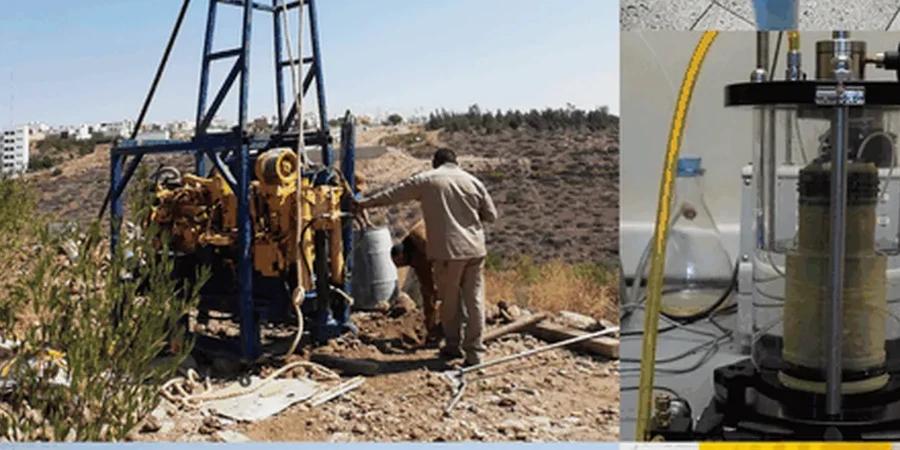
Mississippi River alluvium in Baton Rouge can vary from soft clay to dense sand within three meters, making a detailed soil mechanics study essential for safe foundation design.
Method and coverage
Regional considerations
ASCE 7-22 and the 2021 IBC classify most of Baton Rouge as Seismic Design Category B, but the deep alluvial profiles still produce significant ground motion amplification. Without a proper soil mechanics study that includes vs30/" data-interlink="1">shear wave velocity measurements or CPT correlation, the site class assignment may underestimate the spectral response acceleration. Liquefaction susceptibility in loose, saturated sands below the water table is another hazard that our laboratory testing protocol addresses directly via cyclic triaxial testing and SPT-based triggering analysis. Ignoring these site-specific risks in Baton Rouge can lead to differential settlements exceeding two inches or even foundation bearing failure during a moderate seismic event.
Standards that apply
ASTM D1586-18 Standard Test Method for Standard Penetration Test (SPT), ASTM D2487-17 Standard Practice for Classification of Soils for Engineering Purposes (Unified Soil Classification System), ASCE 7-22 Minimum Design Loads and Associated Criteria for Buildings and Other Structures (Site Class Definition)
Associated technical services
Field Boring and Sampling
Mobilization of rotary wash or hollow-stem auger rigs for continuous SPT and undisturbed thin-wall tube sampling to depths of 30 meters. Groundwater monitoring wells installed where required.
Laboratory Testing Program
Full classification suite including grain size distribution (ASTM D6913), Atterberg limits (ASTM D4318), compaction (ASTM D698), and strength tests such as triaxial (UU/CU) and direct shear (ASTM D3080).
Geotechnical Report and Recommendations
Integrated analysis with bearing capacity calculations (Terzaghi, Meyerhof), settlement estimates using elastic and consolidation methods, and site class determination per ASCE 7. Seismic hazard screening including liquefaction assessment.
Typical parameters
Common questions
How deep should soil borings go for a typical Baton Rouge residential foundation?
For a two-story house on shallow footings we recommend borings to at least 6 meters, or until encountering the Pleistocene terrace. Deeper borings (10 to 15 m) are necessary for multi-story buildings or when the water table is encountered early. The depth is ultimately determined by the stress bulb of the foundation and local building code requirements.
What is the typical cost range for a soil mechanics study in Baton Rouge?
A standard soil mechanics study for a single-family residence in Baton Rouge typically falls between US$2.700 and US$5.970, depending on the number of borings, laboratory tests, and report complexity. Larger commercial projects scale proportionally. We recommend requesting a detailed scope-based quote for your specific site.
Do Baton Rouge soils require special consideration for expansive clay behavior?
Yes, many clay layers in the Baton Rouge area have plasticity indices above 30 and can exhibit moderate to high swell potential. Our soil mechanics study includes free swell and swell pressure tests (ASTM D4546) when the plasticity index exceeds 25. If expansive clays are identified, we recommend mitigation measures such as moisture control, chemical stabilization, or deep foundations to bypass the active zone.