Many construction teams in Baton Rouge skip direct soil observation and rely solely on SPT borings. That is a mistake when you need to see the stratigraphy with your own eyes. The Mississippi River floodplain creates complex layering — sandy lenses, organic clays, and stiff clay crusts. A test pit lets you log the soil profile continuously, photograph each horizon, and sample undisturbed blocks. We dig to depths safe for excavation, typically 3 to 5 m, and log every change in color, texture, and moisture. Before pouring any footing in East Baton Rouge Parish, a test pit paired with a placa de carga gives you real bearing data at the exact foundation elevation.
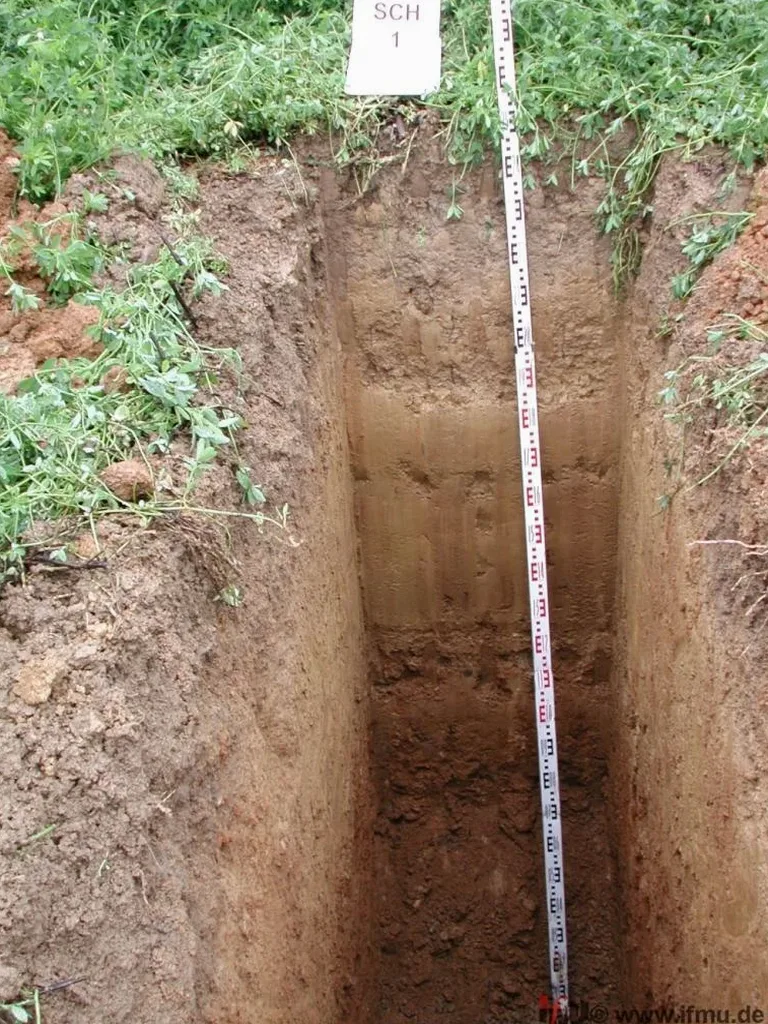
A test pit reveals stratigraphy that no drill rig can show — layers, seams, and hidden groundwater that change foundation design completely.
Method and coverage
- Layer thickness and lateral extent
- Color, plasticity, and dilatancy by feel
- Presence of cobbles, debris, or old fill
- Groundwater seepage rate and depth
- Odor indicating organic or contaminated material
Regional considerations
Consider a slab-on-grade warehouse on the east side of Baton Rouge. The geotechnical report from borings alone showed uniform lean clay. A test pit exposed a 0.6 m soft organic layer at 2.1 m depth that the SPT had missed because the spoon punched through it. Without that pit, the warehouse would have experienced differential settlement exceeding 5 cm within two years. The cost to retrofit would have dwarfed the test pit expense. Missing a weak layer is the real risk — and Baton Rouge has plenty of hidden organic pockets from old oxbow lake deposits.
Standards that apply
ASTM D2488 (visual-manual soil description), ASTM D420 (standard guide for subsurface investigation), OSHA 29 CFR 1926 subpart P (excavation safety), IBC 2018 Section 1803 (geotechnical investigation)
Associated technical services
Foundation Verification Test Pits
Excavate at proposed column or wall locations to confirm bearing stratum. Includes continuous logging, block sampling, and in-situ density.
Utility Route Test Pits
Pits along pipeline or conduit alignments to identify rock, obstructions, or corrosive soils. We log every layer to inform trench design.
Contamination Assessment Test Pits
Open pits for environmental screening — odor, staining, free product. We sample for lab analysis and document stratigraphy for regulatory reporting.
Typical parameters
Common questions
How deep can you dig a test pit in Baton Rouge?
Typically 3 to 5 m using a standard backhoe. Deeper pits require benching or shoring per OSHA rules. The water table in Baton Rouge is shallow — often 1.5 to 3 m — so pits below that need dewatering or casing.
What is the cost range for a test pit investigation in Baton Rouge?
For a standard test pit with logging, sampling, and report, expect between $460 and $900 per pit. Volume discounts apply for three or more pits on the same site.
Can test pits replace SPT borings for foundation design?
Not entirely. SPT gives blow count and disturbed samples for classification. Test pits give visual confirmation, block samples, and lateral continuity. Best practice is to use both: SPT for strength parameters and test pits for stratigraphic detail.