Baton Rouge sits on deep Mississippi River alluvium, a thick sequence of soft clays, silts, and loose sands that amplify ground motion during earthquakes. ASCE 7-22 requires Seismic Design Categories D or E for most of the city, making standard footing assumptions risky. Our team designs foundations that resist lateral spreading and cyclic softening, starting with a site-specific shear-wave velocity profile via [MASW](/masw-vs30/) to determine the correct site class. Without that data, you are guessing on spectral accelerations.
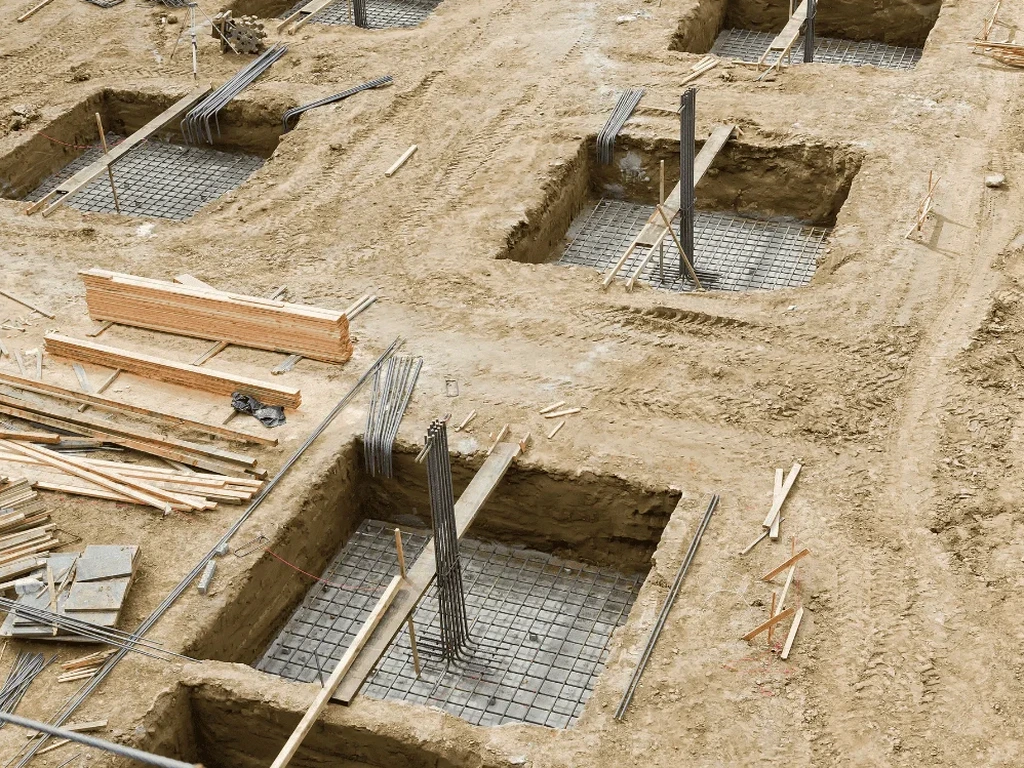
Soft Mississippi River alluvium amplifies seismic waves up to 2.5 times versus rock sites, demanding foundation solutions that resist both shaking and liquefaction.
Method and coverage
Regional considerations
We mobilize a CPT rig with pore-pressure sensors (ASTM D5778-20) to profile soil behavior type in real time. In Baton Rouge, the biggest risk is liquefaction of loose sand lenses buried 10–30 feet deep. A single N-value below 10 blows/ft in those zones can trigger lateral spreading under a moderate M6.5 event. We flag those layers immediately and recommend Improvement like deep soil mixing or stone columns to densify the deposits before foundation placement.
Standards that apply
ASCE 7-22 (Minimum Design Loads, Seismic Provisions), IBC 2021 (Chapter 18, Soils and Foundations), ASTM D1586-18 (Standard Test for SPT), NEHRP Recommended Seismic Provisions (FEMA P-1050)
Associated technical services
Site-Specific Seismic Hazard Analysis
Probabilistic and deterministic hazard assessment using USGS NSHMP data, deaggregation, and site response analysis (SHAKE, DEEPSOIL).
Liquefaction and Lateral Spreading Evaluation
SPT- and CPT-based triggering analysis per NCEER 2001, with post-liquefaction settlement and displacement estimates.
Foundation Design for Cyclic Loading
Pile axial and lateral capacity under cyclic loads, including negative skin friction and group effects in soft clay.
Improvement Verification
Pre- and post-treatment testing (CPT, SASW, plate load) to confirm densification and modulus improvement targets.
Typical parameters
Common questions
What seismic design category applies to Baton Rouge?
Most of Baton Rouge falls under SDC D or E per IBC 2021, based on mapped spectral accelerations (Ss ≈ 0.50 g, S1 ≈ 0.18 g) and site class. The actual category depends on the soil profile measured at your site, not just the map.
How much does a seismic foundation design study cost in Baton Rouge?
The typical cost ranges between US$1,090 and US$4,710, depending on the number of borings, lab testing, and complexity of the site response analysis. A full CPT with pore-pressure dissipation adds to the upper end.
Do I need a site-specific response spectrum for a two-story building?
No for most two-story wood-frame buildings in SDC D, but yes if the building is in SDC E or sits on Site Class F soils (soft clay > 40 ft thick). The IBC 2021 exception for Seismic Force-Resisting Systems does not apply to foundations that must resist overturning on weak soils.