Soil conditions near the Mississippi River in Baton Rouge differ sharply from those around the Comite River basin. The riverfront silts and clays compress more than the sandy terrace deposits east of town. For any large embankment or roadway widening, prefabricated vertical drain (PVD) design must account for that variability. A standard wick drain spacing that works in the Garden District may not accelerate consolidation fast enough near Sherwood Forest. Each project needs site-specific permeability testing and a settlement analysis tied to local stratigraphy. We combine that data with a consolidation study to predict how fast pore pressures will dissipate under load. The goal is a realistic construction schedule, not a generic assumption.
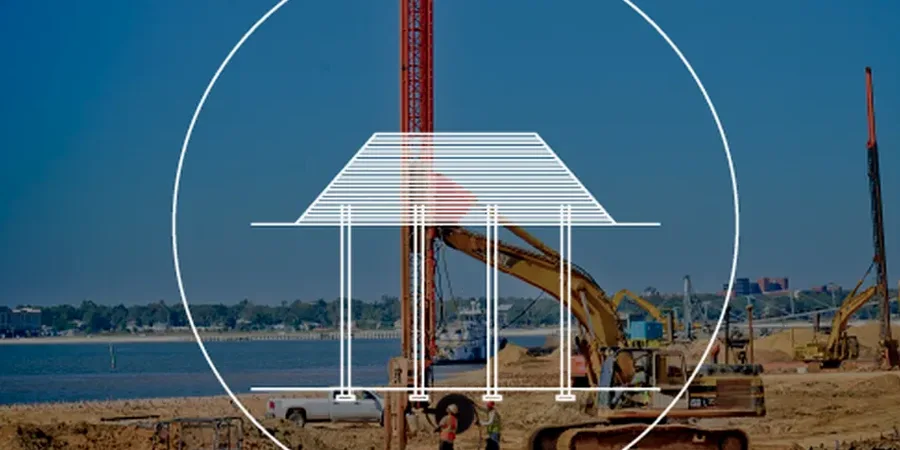
A 4.5-foot triangular grid in Baton Rouge alluvial clay achieved 90% consolidation in six months, matching the predicted timeline within 10%.
Method and coverage
Regional considerations
ASCE 7 and IBC both require differential settlement limits for structures adjacent to new fills. In Baton Rouge, where the near-surface soils are mostly soft clay and silt, exceeding those limits is a real risk. A poorly designed prefabricated vertical drain system can leave excess pore pressure locked in the ground. That trapped pressure causes consolidation to stall, and settlement continues long after the fill is placed. Roads crack, bridge approaches settle, and utility lines fail. We check the PVD design against the local groundwater table — typically 3 to 6 feet deep — and the compressibility of each stratum. Only then do we finalize the drain pattern.
Standards that apply
ASTM D1586-18 (SPT for soil profiling), ASTM D2435-04 (one-dimensional consolidation), FHWA NHI-16-072 (PVD design guidelines), IBC 2021 Chapter 18 (foundations and embankments)
Associated technical services
Consolidation and Settlement Analysis
Laboratory oedometer tests on undisturbed samples from the site. We determine cv, ch, and the compression index for each clay layer. The analysis produces a time-settlement curve with and without PVDs.
PVD Installation Supervision
On-site monitoring of drain spacing, depth, and mandrel extraction speed. We verify that the sand blanket meets gradation specs and that the discharge layer connects properly to the drainage system.
Typical parameters
Common questions
How long does it take for PVDs to achieve 90% consolidation in Baton Rouge clay?
With a 4.5-foot triangular grid, most Baton Rouge alluvial clay sites reach 90% consolidation in 4 to 8 months. The exact time depends on the horizontal permeability of each clay layer and the total fill height. We run site-specific consolidation tests to give a reliable schedule.
What is the typical cost range for a prefabricated vertical drain design study in Baton Rouge?
For a standard embankment or roadway project, our PVD design study — including field permeability testing, consolidation lab work, and the drain spacing analysis — typically ranges from US$920 to US$2,380. The final cost depends on the number of soil layers and the area to be treated.
Do PVDs work in Baton Rouge soils with high organic content?
Yes, but the organic layers must be tested separately. Peat and muck have much lower permeability than typical clay. The drain spacing may need to be reduced to 3 feet or less in those zones. We also recommend a surcharge load to help compress the organic material before final grade is placed.